Global Space Technology Market Projected to Reach $1.14 Trillion by 2034
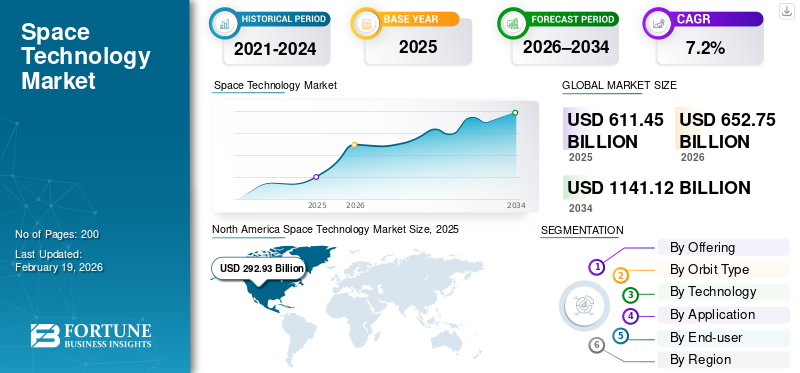
The global space technology market is forecast to grow from $611.45 billion in 2025 to over $1.14 trillion by 2034, representing a compound annual growth rate of 7.2%. This expansion is primarily driven by the rapid commercialization of space, the deployment of large satellite constellations, and the integration of generative AI into mission planning and spacecraft design. As North America continues to lead the sector with nearly half of the market share, the industry is shifting toward more cost-effective solutions like reusable launch vehicles and in-space manufacturing.
The global space technology market is entering a period of significant expansion, with its valuation expected to rise from $652.75 billion in 2026 to $1,141.12 billion by 2034. North America currently dominates the landscape, accounting for 47.91% of the market share in 2025. Within the sector, the commercial segment has emerged as the primary driver, holding the majority share in 2025 and projected to represent 37.6% of the market by 2026. This segment is anticipated to experience the highest growth rate at a CAGR of 8.1%, as private enterprises increasingly invest in satellite communications, broadband connectivity, and Earth observation to meet global demand for real-time data.
Technological advancements are fundamentally reshaping the economics of space operations, most notably through the development of reusable launch vehicles and generative AI. Major players including SpaceX, Airbus SE, Astra, and General Dynamics are leveraging these innovations to enhance operational efficiency and reduce the traditionally high costs associated with orbital missions. Generative AI is being utilized to accelerate spacecraft component design and improve autonomous navigation, while reusable rockets allow for the recovery of boosters and engines, significantly shortening turnaround times between missions. Furthermore, in-space manufacturing (ISM) is gaining traction as a way to produce large-scale structures and specialized materials in microgravity, bypassing the mass and size limitations of Earth-based launches.
The demand for sophisticated space technology is largely driven by the needs of modern industries such as telecommunications, defense, and logistics, which rely on satellite systems for navigation, IoT networks, and geospatial intelligence. However, the industry remains highly capital-intensive, with single orbital launches costing tens to hundreds of millions of dollars. These high financial barriers often force companies to prioritize proven technologies over experimental innovations, potentially slowing the overall pace of advancement. Despite these challenges, the shift toward commercial-led initiatives and the proliferation of satellite-based services continue to stimulate demand for new hardware, software, and ground infrastructure across the global market.
Summary generated by RabbitReport AI from public reporting. The full article and original reporting belong to Fortune Business Insights.