North America Textile Market Projected to Reach $201.3 Billion by 2035 Driven by Apparel and Synthetic Fibers
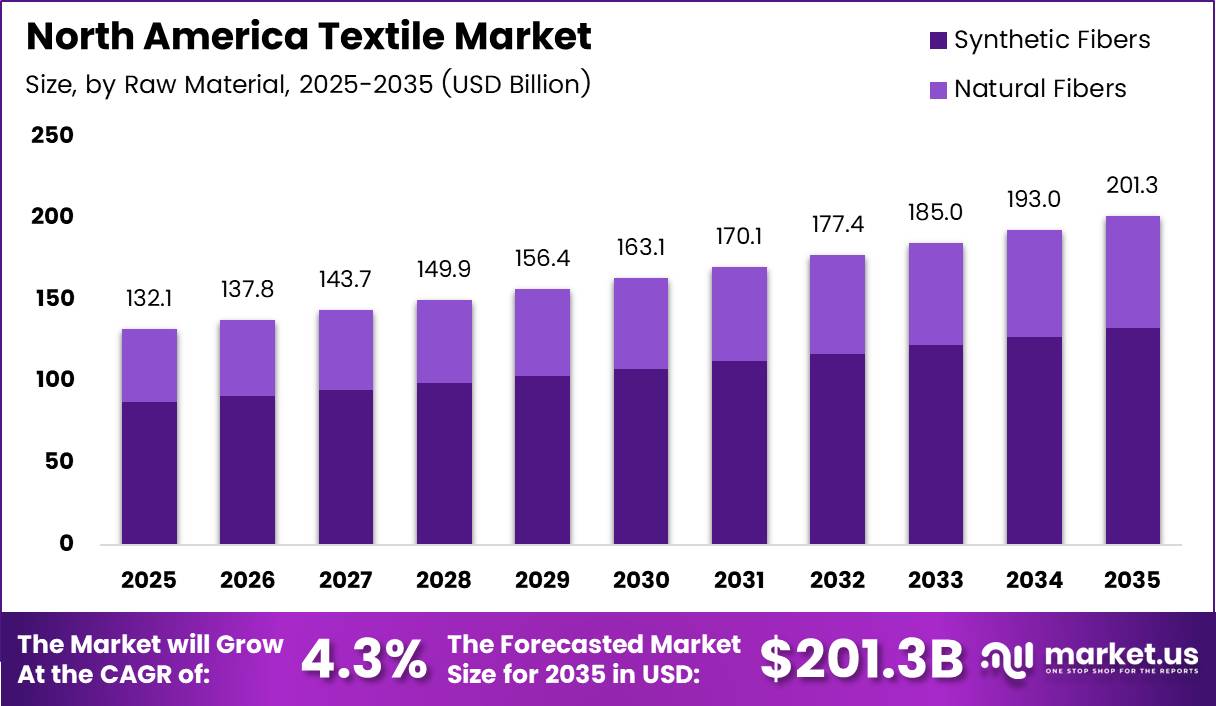
The North America textile market is forecasted to grow from $132.1 billion in 2025 to approximately $201.3 billion by 2035, representing a steady compound annual growth rate of 4.3%. Fashion and apparel remain the dominant application for these materials, accounting for 37.4% of the total market share. This growth is underpinned by significant capital investment in domestic manufacturing infrastructure and a strategic shift toward high-performance synthetic fibers and technical textiles.
The North American textile industry is entering a decade of expansion, with the market expected to add over $69 billion in value by 2035. Synthetic fibers currently anchor the supply side, commanding a significant 65.9% share of the raw material segment due to their cost efficiency and performance versatility. While natural fibers maintain a presence in premium and medical sectors, the market's volume is heavily driven by synthetics that offer predictable supply chains for mass-market apparel and industrial uses.
In terms of production technology, woven fabrics lead the market with a 41.8% share, valued for their dimensional stability across both industrial and fashion applications. However, knitted fabrics are seeing increased traction in the activewear and casualwear sectors, exemplified by product innovations such as the January 2025 launch of SPANXsculpt™ ReDefine utilizing LYCRA FitSense® Denim Technology. This shift toward performance-oriented materials reflects a broader consumer preference for comfort and functionality in everyday clothing.
Domestic manufacturing in the United States is being bolstered by sustained capital deepening to counter the pressure of rising imports. According to the National Council of Textile Organizations, investment in U.S. textile mills rose from $1.85 billion in 2013 to $2.98 billion in 2022, part of a larger $22.3 billion decade-long commitment to new plants and equipment. These investments are enabling producers to specialize in high-margin frontiers like technical textiles for the automotive and medical sectors, moving away from commodity volume production to maintain a competitive edge.
Summary generated by RabbitReport AI from public reporting. The full article and original reporting belong to Market.us.