IMS Business Report 2026: Global Electronic Music Industry Now Worth $15.1 Billion
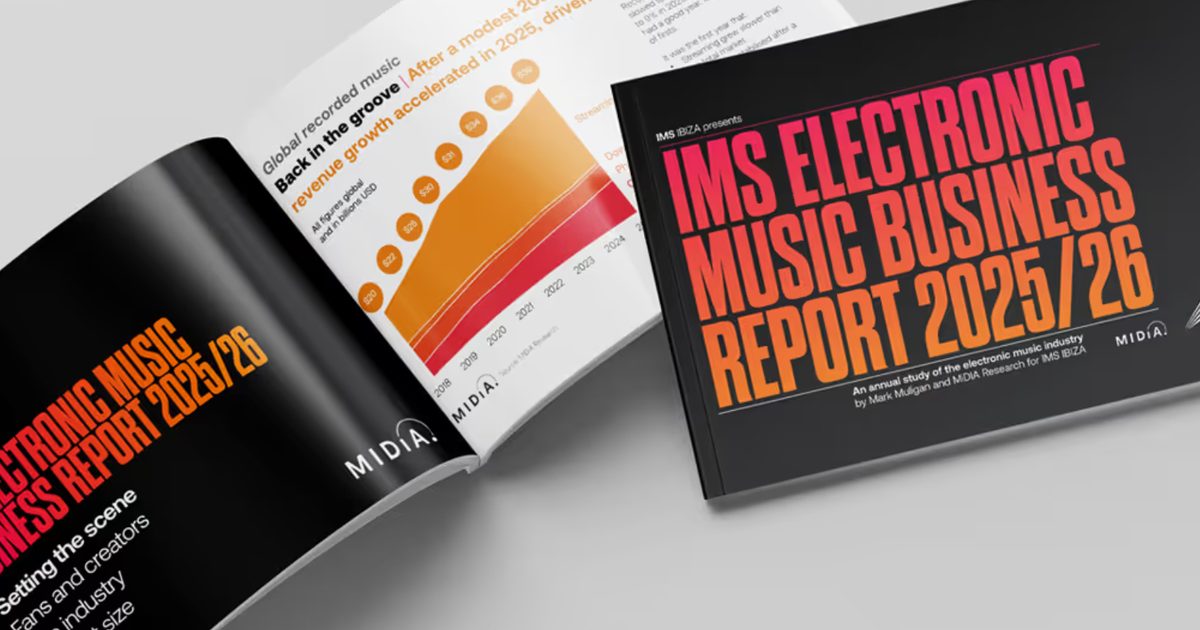
The global electronic music industry reached a record valuation of $15.1 billion in 2025, marking a 7% growth rate according to the latest IMS Business Report. This expansion comes as the sector pivots from a streaming-heavy consumption model toward a "fan economy" driven by expanded rights, including merchandise and direct-to-consumer sales. The report highlights a significant shift in geographic influence toward the Global South and a massive surge in the adoption of generative AI tools within the production landscape.
Compiled by MIDiA Research and presented at IMS Ibiza, the report reveals that the electronic music sector grew by 7% in 2025, surpassing the $14.2 billion valuation recorded the previous year. MIDiA founder Mark Mulligan noted that the industry's resilience against global uncertainty is bolstered by the "escapist role of the dance floor." While streaming growth slowed relative to the total market for the first time, labels found significant gains in expanded rights—encompassing sponsorships and direct-to-consumer sales—which surged by 21%. Industry leaders are increasingly looking to the South Korean model, with mid-cap labels like HYBE and SM Entertainment outpacing majors in fandom-driven revenue growth.
The industry's growth engine has shifted toward the Global South, with Indonesia emerging as a powerhouse following a 77% increase in electronic music listeners on Spotify. In established hubs like Ibiza, a "paradox" has emerged: club ticketing revenues hit a record €160 million (~$188 million USD) in 2025 even as the number of events per venue decreased to an average of 140. This indicates a move toward high-efficiency, high-yield programming. However, the report warns of challenges in the US market, where ticket sales dipped due to cost-of-living pressures, emphasizing the need to keep dancefloors accessible to younger audiences.
Technological integration reached a "step change" in 2025, with revenue from generative AI and stem-separation tools skyrocketing by 651% since 2023 to reach $333 million. This tech boom is mirrored in shifting sonic trends, such as the rise of "harder and faster" music like Schranz and the meteoric 82% search increase for Afro House on Splice. From an investment perspective, electronic music is becoming a prime target for catalog deals, representing 18% of all announced transactions. Investors are particularly drawn to the "young" profile of these catalogs, which have an average vintage of 2005 compared to the 1990 average for other genres, offering higher engagement potential on platforms like TikTok.
Despite the financial gains, the report indicates that progress in industry diversity remains slow. Female registered users on AlphaTheta platforms rose only slightly to 15% in 2025, up from 13% in 2023, signaling a need for deeper structural changes. Germany maintains its position as the world's largest market for electronic music, contributing to an 11% overall growth across top global markets. As the ecosystem matures, the industry is increasingly focused on leveraging AI creation tools and local scenes to sustain its $15.1 billion trajectory while navigating a slight decline in electronic representation at major festivals.
Summary generated by RabbitReport AI from public reporting. The full article and original reporting belong to Beatportal.