Light Rail Market Size to Hit USD 110.58 Billion by 2035
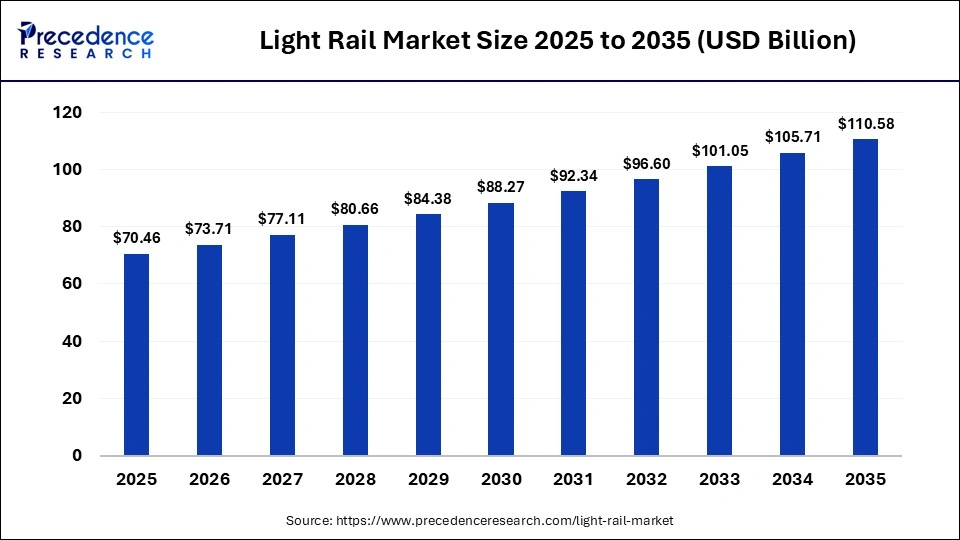
The global light rail market is projected to grow from USD 70.46 billion in 2025 to approximately USD 110.58 billion by 2035, representing a compound annual growth rate of 4.61%. This expansion is primarily driven by rapid urbanization, increased government infrastructure investment, and a global shift toward sustainable, low-emission urban mobility solutions. The sector is undergoing a significant digital transformation as transit agencies integrate advanced technologies to modernize existing networks and connect underserved regions.
The global light rail market is entering a period of sustained growth, with valuations expected to rise from USD 73.71 billion in 2026 to over USD 110 billion by 2035. This expansion is underpinned by the adoption of state-of-the-art technologies, including energy-efficient vehicles and digital signaling systems that improve ridership and service reliability. Artificial intelligence is becoming a cornerstone of the industry, with operators utilizing AI for predictive maintenance, real-time defect detection, and automated inspections to lower operational costs and minimize downtime. Furthermore, AI-driven demand forecasting and scheduling tools are being deployed to optimize train frequency and capacity utilization across expanding urban networks.
Segment data from 2025 shows that trams and streetcars dominated the market with a 52% share, primarily due to their lower construction complexity and suitability for city-center circulation. However, the light rail transit (LRT) segment is identified as the fastest-growing area with a 3.9% CAGR as cities develop dedicated rights-of-way to connect suburban areas and airports to high-density corridors. Vehicle capacity trends also show a distinct split; while the 200–400 passenger segment held a 50% share in 2025 due to its operational flexibility and lower axle weight, the high-capacity segment for over 400 passengers is growing at a faster 4.2% CAGR. This shift toward multi-articulated trains is particularly prevalent in megacities where limited land availability prohibits station expansions.
Urban and intra-city transport remains the primary application for light rail, capturing a 65% market share in 2025 by providing essential last-mile connectivity and supporting policy-directed shifts in modal shares. These systems are increasingly integrated with metro and bus networks to form the basis of comprehensive urban mobility plans aimed at reducing emissions and traffic congestion. To help expedite the construction of these complex systems, public-private partnerships have emerged as a vital mechanism for funding and long-term planning. This transition toward digitalization is creating increased competition and new business opportunities for global rail technology companies, which are implementing advanced computer vision and analytics tools to enhance passenger security and infrastructure monitoring.
Summary generated by RabbitReport AI from public reporting. The full article and original reporting belong to Precedence Research.