Rolling Stock Market Projected to Reach $78.93 Billion by 2034 Driven by Electrification and Urbanization
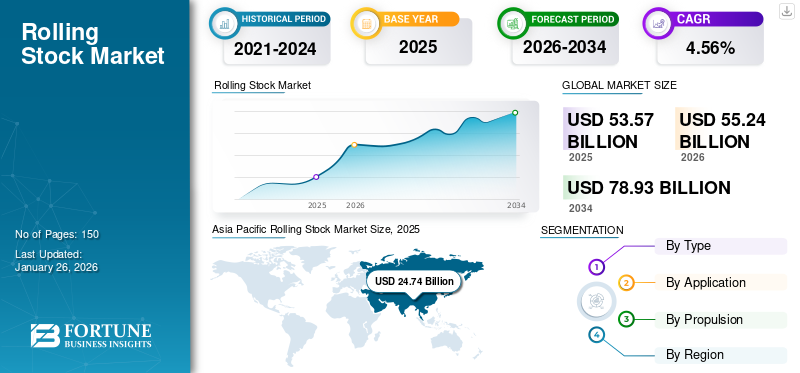
The global rolling stock market is poised for steady growth, with its valuation expected to rise from USD 53.57 billion in 2025 to nearly USD 79 billion by 2034. This expansion is primarily fueled by large-scale rail electrification, the modernization of public transit systems, and significant infrastructure investments in emerging economies. For the rail and public transit sector, these trends signal a shift toward more sustainable, digitally integrated fleets designed to meet increasing passenger and freight demands.
The global rolling stock industry is experiencing a period of measured expansion, with the Asia Pacific region currently accounting for 46.18% of the market share. Growth is being propelled by a combination of urbanization and the expansion of freight corridors, alongside significant financial backing such as the USD 660 million World Bank loan for Turkey’s electric rail expansion. Leading manufacturers like CRRC, Siemens, Alstom, Kawasaki, and Wabtec are focusing on diverse solutions ranging from high-speed rail to advanced freight wagons to maintain their competitive edge in this evolving landscape.
A primary driver for the sector is the rapid shift toward electrification, as governments move away from diesel propulsion to meet sustainability goals. Electric trains are increasingly favored for their lower maintenance requirements, energy efficiency, and the inclusion of regenerative braking systems. A key development in this area is Amtrak’s USD 2.45 billion investment in its NextGen Acela fleet, which is scheduled to debut in 2025. These 28 high-speed trains are designed to reach speeds of 160 mph while reducing energy consumption by 20% compared to previous models.
Beyond propulsion, the market is being reshaped by digitalization and the integration of smart technologies. Procurement decisions now heavily weigh lifecycle costs and the inclusion of on-board diagnostics and predictive maintenance systems to maximize operational uptime. While the industry faces potential hurdles such as geopolitical instability and budget constraints, the demand for high-speed rail and the need to replace aging infrastructure in mature economies ensure a steady pipeline of projects through the next decade.
Summary generated by RabbitReport AI from public reporting. The full article and original reporting belong to Fortune Business Insights.