Autonomous Train Market Size, Share | Industry Report [2034]
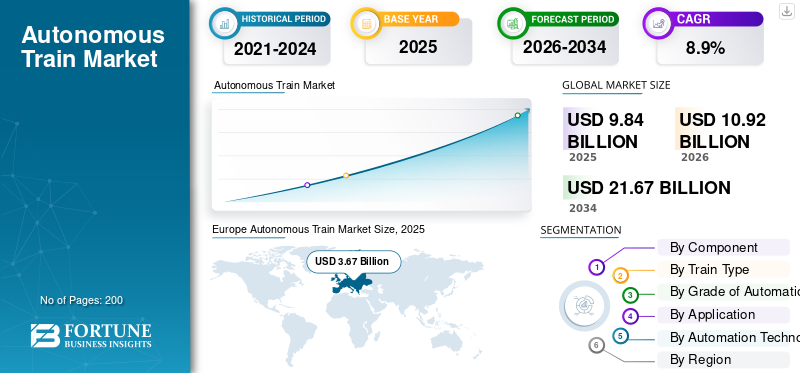
The global autonomous train market is poised for significant expansion, with its valuation expected to rise from $9.84 billion in 2025 to $21.67 billion by 2034. This growth is primarily fueled by the urgent need for efficient public transportation and increasing government investments in modernizing rail infrastructure across Europe, North America, and the Asia Pacific. As urbanization intensifies, the transition toward driverless systems is becoming a critical strategy for rail operators to enhance safety, reduce human error, and optimize operational precision.
The autonomous train sector is characterized by a steady 8.9% compound annual growth rate, with Europe currently holding a dominant 37.30% market share as of 2025. Major industry participants, including Siemens Mobility, Alstom, Hitachi Rail, Thales Group, CRRC Corporation Limited, and Wabtec Corporation, are competing through the development of digital signaling systems and AI-driven automation. These technologies allow for rail systems to operate with minimal human intervention, utilizing advanced sensors and control systems to manage high-frequency services in increasingly congested urban environments.
A major shift is occurring through the integration of artificial intelligence and predictive maintenance, which allows operators to monitor component health in real time. This digitalization helps minimize unexpected failures and maintenance costs while improving the overall lifecycle management of rail assets. The software and AI systems segment is notably projected to grow at a higher CAGR of 11.0%, reflecting the industry's move toward smart monitoring and data analytics. Furthermore, the adoption of advanced signaling and IoT-enabled systems is facilitating seamless coordination between trains and control centers to enhance system-wide performance.
Despite the positive outlook, the market faces significant hurdles, most notably the high capital investment required for upgrading legacy infrastructure and integrating complex signaling systems. Financial barriers remain a concern for developing regions, while the industry must also address cybersecurity risks associated with interconnected digital networks. However, the expansion of autonomous technology into freight rail presents a substantial opportunity to optimize long-haul cargo movement and reduce operational costs. As global trade grows, the move toward driverless freight solutions is expected to create new revenue streams and further modernize the global transportation ecosystem.
Summary generated by RabbitReport AI from public reporting. The full article and original reporting belong to Fortune Business Insights.