Global Cold Chain Logistics Market Expected to Surpass $1.1 Trillion by 2034
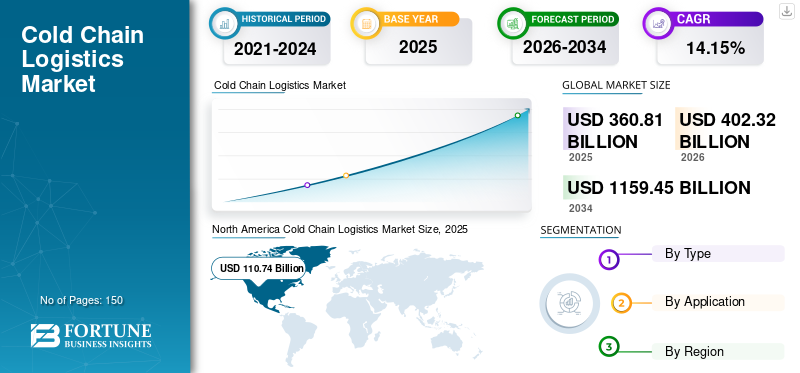
The global cold chain logistics market is projected to grow from $360.81 billion in 2025 to over $1.15 trillion by 2034, representing a compound annual growth rate of 14.15%. This rapid expansion is driven by the globalization of perishable food trade, the rise of e-commerce grocery services, and the critical requirements of the pharmaceutical sector. For the logistics and supply chain industry, this growth necessitates significant investment in specialized infrastructure and advanced monitoring technologies to comply with increasingly stringent global regulations.
The global cold chain logistics market is entering a period of significant expansion, with its valuation expected to rise from USD 402.32 billion in 2026 to USD 1,159.45 billion by 2034. In 2025, the market was led by the Asia Pacific region, which held a 34.80% share valued at USD 125.55 billion, followed by North America with a 30.69% share at USD 110.74 billion and Europe at 25.06% or USD 90.44 billion. The industry is currently bifurcated into refrigerated warehouses, which hold the majority market share due to a global shift toward packaged and frozen foods, and refrigerated transportation, which is expected to be the fastest-growing segment across air, sea, rail, and road modalities.
The pharmaceutical and healthcare sectors are primary catalysts for this growth, a trend accelerated by the COVID-19 pandemic's demand for vaccine and biologic distribution. According to the International Federation of Pharmaceutical Manufacturers & Associations (IFPMA), global pharmaceutical sales are expected to reach USD 1.5 trillion by 2024, with a vast portion requiring strict temperature controls. The industry is seeing a transition toward personalized medicine and complex biologics, such as mRNA vaccines, monoclonal antibodies, and gene therapies. Consequently, regulatory bodies like the U.S. Food and Drug Administration (FDA) and the European Medicines Agency (EMA) have enforced rigorous guidelines, requiring logistics providers to invest in state-of-the-art cold chain infrastructure and real-time temperature-monitoring devices.
Beyond healthcare, the rise of online grocery platforms and direct-to-consumer healthcare services is creating new demand for automated warehouses and innovative last-mile delivery solutions. However, the industry faces substantial environmental hurdles as it scales. Refrigeration is highly energy-intensive and a major source of greenhouse gases, with refrigerated transportation accounting for approximately 7% of global hydrofluorocarbon (HFC) consumption. Furthermore, diesel-powered reefer trucks and containers consume about 21% more power than standard units, leading to significant climate change implications that may hinder market growth as developing nations expand their infrastructure and face increasing pressure to reduce emissions.
Summary generated by RabbitReport AI from public reporting. The full article and original reporting belong to Fortune Business Insights.