Machine Learning in Logistics Market Projected to Reach $47.6 Million by 2035
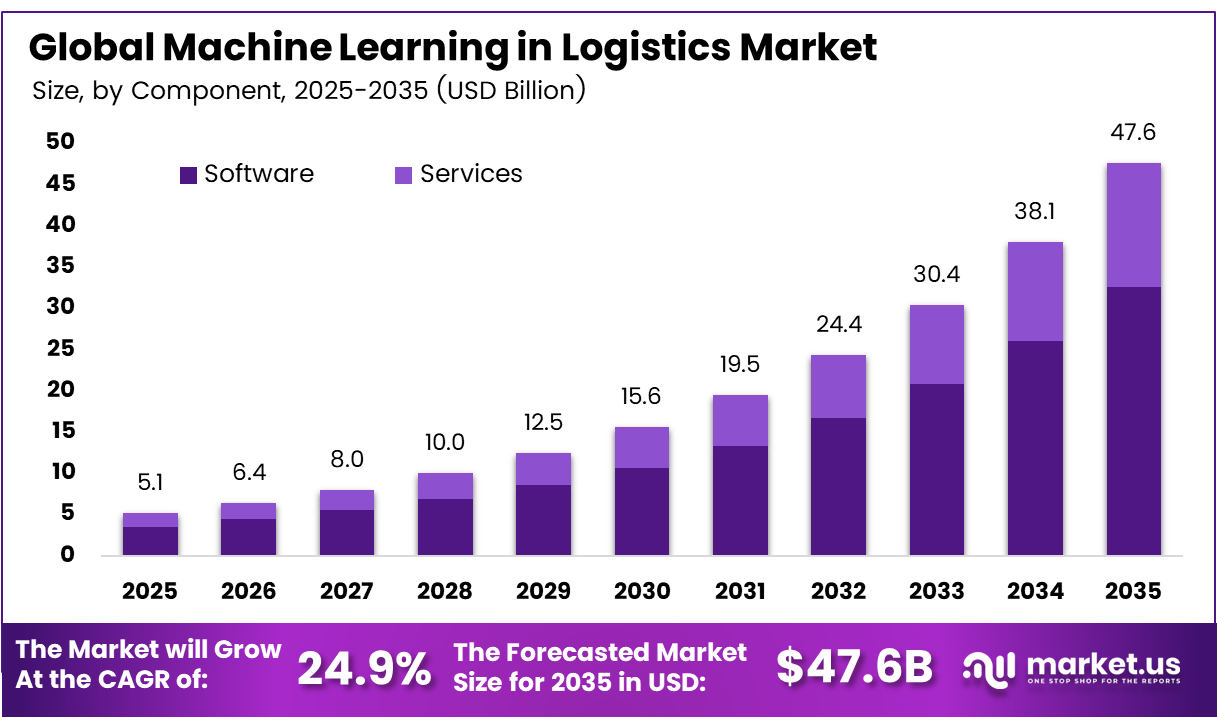
The global machine learning in logistics market is forecasted to grow from $5.1 million in 2025 to $47.6 million by 2035, representing a robust compound annual growth rate of 24.9%. This expansion is primarily driven by the rising complexity of global supply chains and the urgent need for enhanced demand forecasting, route optimization, and warehouse efficiency. As e-commerce volumes continue to climb and pressure to reduce carbon emissions intensifies, logistics providers are increasingly adopting intelligent algorithms to maintain 24/7 visibility and manage fluctuating operational costs.
The global market for machine learning in logistics is entering a period of significant expansion, with North America currently maintaining a dominant position by capturing a 44.8% market share and generating $2.2 million in revenue. Within the United States specifically, the market is valued at $2.1 million and is projected to grow at a CAGR of 22.4%, supported by mature digital infrastructure and high automation spending. Key drivers for this growth include the necessity to manage driver shortages, volatile fuel costs, and the increasing demand for faster delivery cycles. By leveraging large datasets, these machine learning systems can reduce route distances and idle times by several percentage points, providing critical efficiency gains for large-scale distribution networks.
Major technology providers are already rolling out advanced capabilities to meet this demand, such as SAP’s October 2025 update to its Digital Supply Chain suite, which introduced predictive freight analytics and smart warehouse task assignments. These tools, integrated with SAP S/4HANA, allow logistics teams to synchronize transportation planning with yard operations and demand sensing to improve resource utilization. Similarly, IBM expanded its Watson-based machine learning offerings in November 2025 to help enterprises build more resilient logistics frameworks via the IBM Cloud. Beyond traditional machine learning, the industry is seeing a rise in Generative AI applications, which serve as a functional layer for automated document drafting, tender support, and enhanced customer communication.
The implementation of machine learning offers tangible financial benefits for the supply chain sector, including a projected 5% to 10% improvement in on-time delivery and significant reductions in inventory overhead. Predictive maintenance platforms are proving particularly impactful, with the potential to cut unplanned equipment downtime by 20% to 30% through the effective use of sensor data. Investment is increasingly flowing into specialized areas such as cold chain operations, returns handling, and automated control towers that manage various supply chain nodes simultaneously. As companies move from early-stage testing to mature deployment, these technologies are expected to become foundational for maintaining reliable logistics performance and reducing spoilage in an increasingly volatile global market.
Summary generated by RabbitReport AI from public reporting. The full article and original reporting belong to Market.us.