Food Packaging Market Projected to Reach USD 692.6 Billion by 2036 Driven by Sustainability and Shelf-Life Innovation
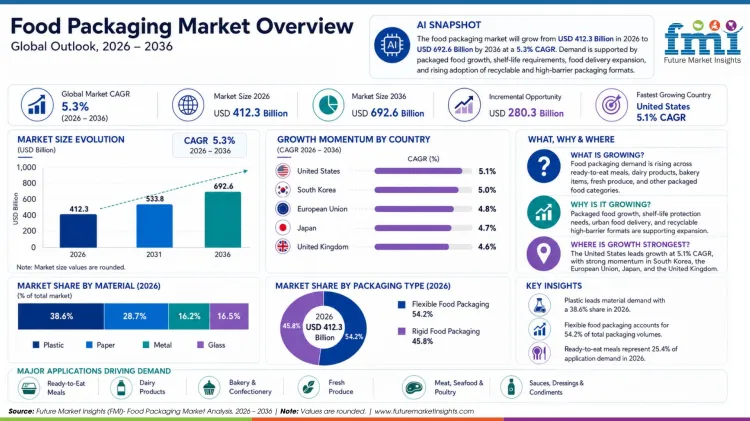
The global food packaging market is forecast to grow at a 5.3% CAGR, expanding from USD 412.3 billion in 2026 to USD 692.6 billion by 2036. This growth is driven by a strategic shift from conventional volume-driven packaging toward higher-value formats that emphasize sustainability, shelf-life extension, and supply chain efficiency. Key industry developments include the rising adoption of recyclable mono-materials and high-barrier flexible packaging to meet evolving regulatory requirements and consumer demand for reduced food waste.
According to Future Market Insights (FMI), the food packaging sector is projected to grow from USD 412.3 billion in 2026 to USD 692.6 billion by 2036, representing a 5.3% CAGR. Plastic remains the primary material, accounting for approximately 38.6% of the market, and is widely used in both flexible and rigid formats for dairy, snacks, and ready meals. China currently maintains the largest market share by value, supported by extensive domestic supply infrastructure and high consumption volumes, while broader growth in Asia is further bolstered by demand in India.
The market is shifting from conventional, volume-driven packaging toward higher-value formats that prioritize sustainability and shelf-life extension. Key trends include the adoption of lightweight materials, recyclable mono-material structures, and high-barrier flexible packaging designed to reduce food waste. These innovations are increasingly critical in application segments such as ready-to-eat meals, dairy products, and fresh produce, where packaging must balance protection with regulatory compliance and environmental impact.
Major industry players like Nestlé are leading the transition by embedding packaging redesign into core product development, focusing on recyclable and reusable formats that improve barrier performance while reducing plastic intensity. Global suppliers such as Amcor are also standardizing plastic-based solutions across dry, chilled, and frozen food lines to support consistent pack formats at scale. FMI notes that as brand owners move beyond basic containment, those who successfully integrate performance-driven, eco-designed packaging will be better positioned to secure long-term supplier relationships in an evolving global market.
Summary generated by RabbitReport AI from public reporting. The full article and original reporting belong to Future Market Insights.