Bus Dispatch Management System Market Projected to Reach $1.27 Billion by 2034
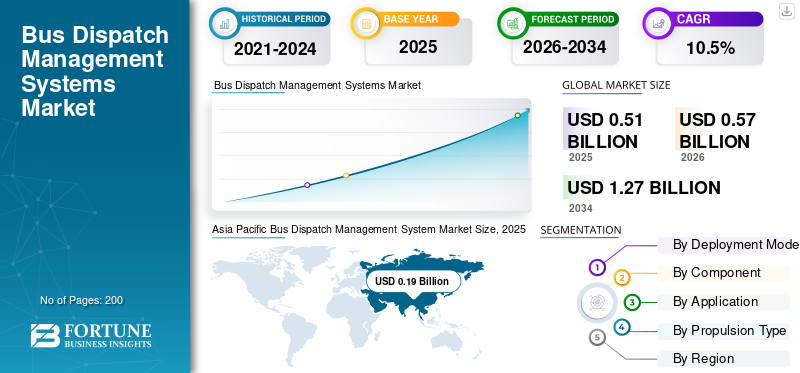
The global bus dispatch management system market is projected to grow from $0.51 billion in 2025 to $1.27 billion by 2034, representing a compound annual growth rate of 10.5%. This growth is primarily fueled by rapid urbanization and government-led smart city initiatives that demand more efficient, technology-enabled public transportation networks. For the fleet management sector, these systems are becoming essential for optimizing routes, managing driver performance, and improving overall passenger service through real-time data integration.
The global bus dispatch management system market is experiencing a significant transformation, with the Asia Pacific region leading the way with a 37.25% market share in 2025. These systems serve as centralized digital platforms that integrate GPS, communication tools, and data analytics to provide real-time planning, scheduling, and tracking across diverse regions. Major industry players, including Trapeze Group, GIRO Inc., Clever Devices, INIT GmbH, Optibus, and IVU Traffic Technologies, are currently competing to provide advanced scheduling algorithms and AI-driven optimization tools to enhance operational efficiency.
A major shift is occurring toward cloud-based deployment models, which currently dominate the market due to their scalability and cost-efficiency. These platforms allow transit agencies to access real-time data and perform remote monitoring without the heavy infrastructure costs associated with on-premises solutions. The integration of Artificial Intelligence (AI) and predictive analytics is also opening new avenues for growth, enabling fleet operators to forecast demand, optimize routes dynamically, and perform predictive maintenance to reduce vehicle downtime. These technologies are increasingly vital as transit authorities seek to improve service reliability and resource allocation.
Despite the positive outlook, the sector faces hurdles related to high initial implementation costs and the technical complexity of integrating new software with legacy transit systems. Financial constraints, particularly in developing regions, can slow the adoption of these digital tools among smaller fleet operators and public transport agencies with limited funding. Furthermore, as these systems rely heavily on real-time data collection and communication, transit authorities must address significant cybersecurity and data privacy concerns to protect sensitive operational and passenger information from potential breaches or system failures.
Summary generated by RabbitReport AI from public reporting. The full article and original reporting belong to Fortune Business Insights.