Silicon-Carbon Battery Market Projected to Reach $3.15 Billion by 2034 as Demand for High-Energy Density Surges
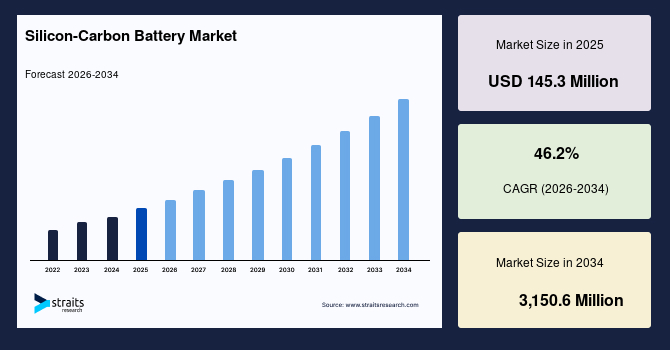
The global silicon-carbon battery market is expected to grow from $145.3 million in 2025 to over $3.15 billion by 2034, representing a robust compound annual growth rate of 46.2%. This expansion is driven by the transition from traditional graphite anodes to silicon-carbon composites, which offer superior energy density and faster charging for electric vehicles and premium electronics. The Asia Pacific region currently leads the market, accounting for a dominant 54.8% share as of 2025.
The silicon-carbon battery market is undergoing a significant transformation as manufacturers seek to overcome the energy limitations of traditional lithium-ion technology. By utilizing silicon-carbon composite anodes instead of conventional graphite, these batteries achieve significantly higher storage capacities and faster charging rates, making them ideal for high-performance applications. This trend is already visible in the consumer electronics sector, where the Honor Magic8 Pro features a 7,100 mAh silicon-carbon battery capable of 100W wired charging. To improve commercial viability and battery life, developers are increasingly adopting pre-lithiation techniques, which have demonstrated the ability to maintain over 98% capacity retention after 2,000 cycles by compensating for initial lithium loss.
Investment in the sector is surging, highlighted by a global scaling effort for SCC55 silicon-carbon anode production led by SK Inc. with participation from Porsche Investments, the Microsoft Climate Innovation Fund, and OMERS. This financial influx coincides with the rise of AI-driven smartphones and wearables, with IDC reporting global smartphone shipments reached 1.17 billion units and wearable shipments hit 538 million units in 2025. Companies like Amprius Technologies and Sila Nanotechnologies are specifically targeting these segments, providing ultra-small, high-energy solutions for next-generation devices that require compact form factors without sacrificing power or increasing device thickness.
Despite the market's potential, significant technical and manufacturing hurdles remain that could limit mass-market adoption. Silicon anodes experience extreme volumetric expansion of 300% to 400% during lithiation, leading to mechanical stress, particle cracking, and unstable solid electrolyte interphase (SEI) formation which causes rapid capacity fade. Additionally, these systems generate up to 77% more internal heat during fast charging compared to graphite cells, requiring advanced thermal management and safety architectures. The industry also struggles with a lack of standardized manufacturing processes, which increases production complexity and costs for battery manufacturers aiming for large-scale deployment.
Summary generated by RabbitReport AI from public reporting. The full article and original reporting belong to Straits Research.