Cloud Computing Market Size, Share & Growth Report, 2034
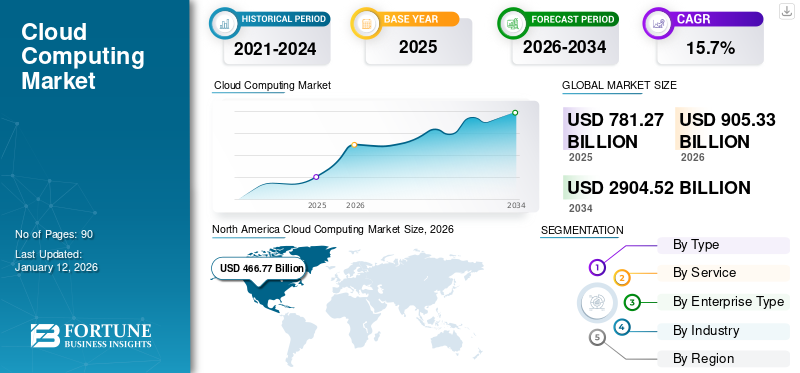
The global cloud computing market is forecasted to grow from $781.27 billion in 2025 to over $2.9 trillion by 2034, representing a compound annual growth rate of 15.7%. This expansion is primarily fueled by enterprise digital transformation, the integration of artificial intelligence, and the widespread adoption of hybrid and multi-cloud architectures. As hyperscale providers expand their global footprint, the sector is increasingly influenced by the demand for specialized GPU capacity and sovereign cloud solutions to meet regulatory requirements.
The global cloud computing industry is entering a period of significant expansion, with its valuation expected to climb from USD 905.33 billion in 2026 to USD 2,904.52 billion by 2034. In 2025, North America led the market with a 52.0% share valued at USD 406.08 billion, followed by Europe at 22.7% with USD 177.14 billion and Asia Pacific at 13.3% with USD 104.24 billion. This growth is underpinned by sustained capital investment from hyperscale providers and the rapid modernization of business operations through big data, IoT, and 5G technologies.
Artificial intelligence has emerged as a critical driver of compute intensity, shifting the focus of cloud providers toward AI readiness and GPU availability. Neocloud platforms are gaining strategic importance as specialized providers of GPU cloud environments, while traditional hyperscalers are embedding machine learning toolkits and generative model infrastructure into their core offerings. Infrastructure as a Service (IaaS) is seeing increased adoption for capital efficiency, whereas Software as a Service (SaaS) remains the dominant model for recurring enterprise software consumption. The availability of high-performance computing clusters and energy-efficient data center designs is now a primary factor in capturing incremental market demand.
The competitive landscape is evolving beyond geographic scale to include sovereign cloud initiatives and industry-specific solutions tailored for sectors like banking and healthcare. Enterprises are increasingly adopting hybrid and multi-cloud strategies to mitigate concentration risk and optimize pricing, while Omni-cloud platforms are being leveraged to integrate data across disparate systems. Furthermore, the market is becoming more fragmented with the emergence of over 100 startups, forcing established players to innovate continuously. Sustainability is also becoming a differentiator, as providers integrate renewable energy sourcing and carbon reporting tools to meet growing environmental accountability requirements in procurement.
Summary generated by RabbitReport AI from public reporting. The full article and original reporting belong to Fortune Business Insights.