Sovereign Cloud Market Projected to Reach $1.3 Trillion by 2034 Driven by AI and Regulatory Demand
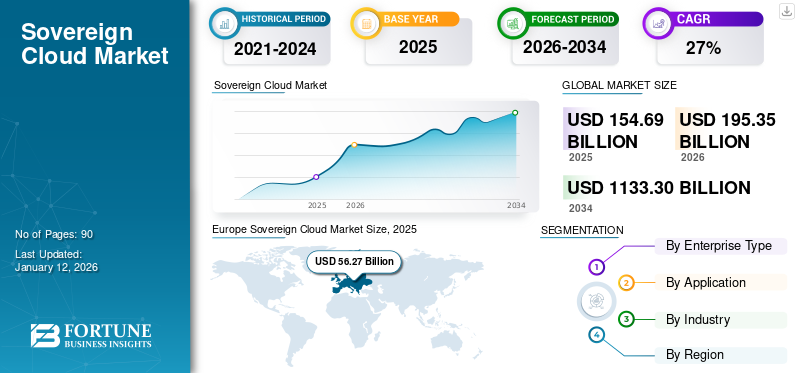
The global sovereign cloud market is poised for massive expansion, with its valuation expected to grow from $154.69 billion in 2025 to over $1.3 trillion by 2034. This growth is primarily fueled by increasing regulatory requirements for data residency and the rapid integration of generative AI, which necessitates secure, compliant environments for processing sensitive enterprise information. As governments and highly regulated industries prioritize digital sovereignty, the sector is shifting toward a partnership model that blends hyperscale technology with local operational control.
According to recent industry data, the sovereign cloud market is exhibiting a robust compound annual growth rate of 27.0%, with Europe currently leading the sector with a 36.37% market share in 2025. Major hyperscalers including Microsoft, Amazon Web Services, Oracle, Google, and IBM are increasingly forming strategic alliances with regional telecommunications operators and technology firms to build compliant ecosystems. These collaborations allow global providers to offer advanced cloud capabilities while ensuring that data remains within specific geographical boundaries to satisfy local privacy laws and governance standards.
Generative AI has emerged as a critical driver for sovereign cloud adoption, as organizations utilize these tools to analyze vast datasets such as financial reports and internal operational documents. This shift has raised significant concerns regarding data residency and privacy, prompting enterprises in the banking, healthcare, energy, and telecommunications sectors to seek infrastructure that supports AI innovation without compromising legal compliance. Consequently, the market is moving toward co-developed offerings where hyperscalers provide the underlying technology and local partners manage day-to-day operations and legal control.
Establishing sovereign cloud environments requires a dedicated physical infrastructure base, including local data centers, isolated networks, and geo-specific operational staff, which involves significantly higher capital investment than standard public clouds. While these costs may present barriers for small and medium-sized enterprises, governments are stepping in with funding to prioritize domestic digital sovereignty and reduce reliance on foreign services. These public investments are creating long-term commercial opportunities for providers capable of delivering the scalability of the cloud within strictly defined legal jurisdictions.
Summary generated by RabbitReport AI from public reporting. The full article and original reporting belong to Fortune Business Insights.