Global Additive Manufacturing Equipment Market Projected to Reach $35.20 Billion by 2034
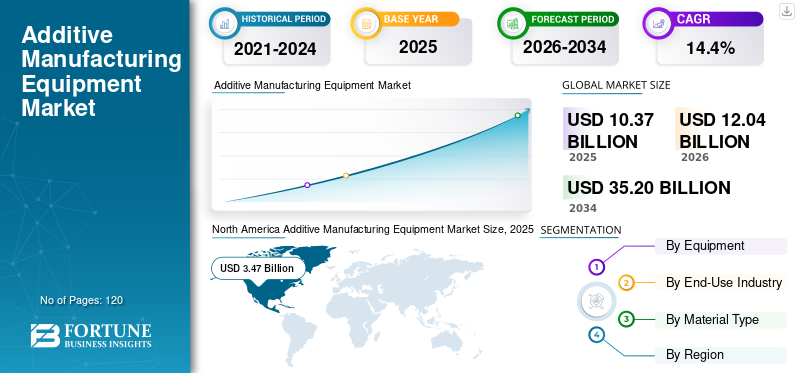
The global additive manufacturing equipment market is forecast to grow from $10.37 billion in 2025 to $35.20 billion by 2034, representing a compound annual growth rate of 14.4%. This expansion is driven by the increasing industrialization of metal 3D printing for serial production and the rising demand for lightweight, complex components in the aerospace, healthcare, and automotive sectors. As companies integrate these systems into production workflows to reduce waste and shorten lead times, the sector is shifting toward high-precision, automated industrial-scale manufacturing.
The market is characterized by significant investment from major industry players, including Stratasys Ltd., 3D Systems Corporation, EOS GmbH, GE Additive, Nikon SLM Solutions, and HP Inc., among others. North America currently leads the global landscape, holding a 33.46% market share in 2025, with the U.S. market alone estimated to reach $3.37 billion by 2026. This regional dominance is supported by advanced industrial capabilities and early adoption of digital manufacturing technologies within the aerospace and defense sectors, alongside extensive R&D activities from established equipment manufacturers.
Technological segmentation reveals that powder bed fusion (PBF) systems, including SLS, SLM, and EBM, hold the highest market share due to their ability to produce high-precision metal and polymer parts with superior mechanical properties. However, vat photopolymerization is expected to see the fastest growth with a 14.6% CAGR, driven by serial production applications. In terms of materials, metals currently dominate the market share as industries like energy and healthcare adopt titanium and nickel-based alloys, while the polymer segment is projected to grow at a 13.3% CAGR through 2034, supported by increasing demand for industrial printing.
Growth is primarily fueled by the aerospace and defense industry, which utilizes additive manufacturing for engine and structural components to improve fuel efficiency and reduce assembly complexity. The healthcare sector is also a major contributor, projected to grow at a 15.7% CAGR due to rising demand for patient-specific implants and customized dental devices. Despite these opportunities, the industry faces hurdles such as high capital investment and operational costs for small and medium-sized manufacturers, as well as rigorous qualification and certification requirements that can increase implementation complexity and production timelines.
Summary generated by RabbitReport AI from public reporting. The full article and original reporting belong to Fortune Business Insights.