Japan 3D Printing Market Size to Hit USD 3,054.40 Million by 2035
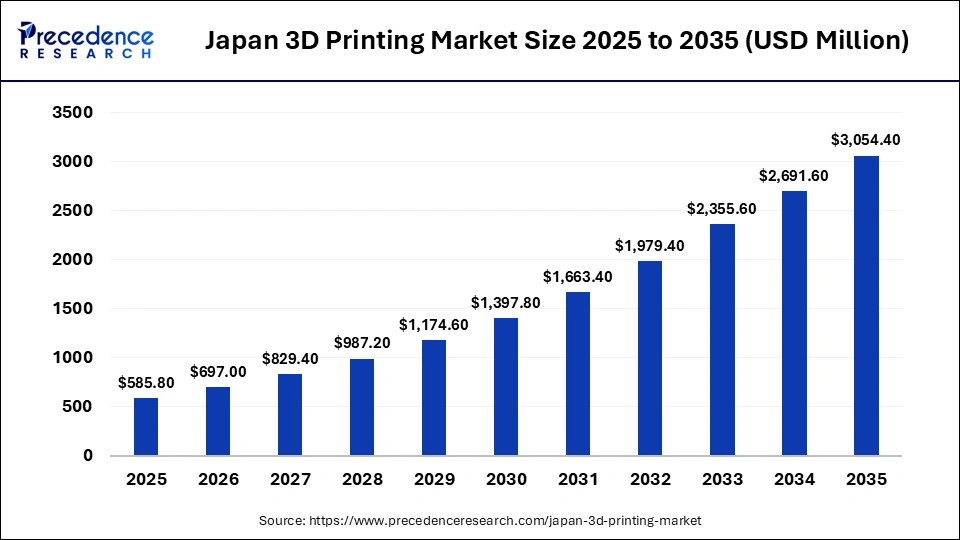
The Japanese 3D printing market is poised for significant expansion, with its valuation expected to grow from USD 585.80 million in 2025 to over USD 3.05 billion by 2035. This growth is driven by the nation's established expertise in precision engineering and a robust integration of additive manufacturing into the aerospace, automotive, and healthcare sectors. As the industry shifts toward industrial-grade hardware and digital manufacturing workflows, Japan is leveraging advanced material science and robotics to enhance supply chain resilience and sustainable production.
The Japanese additive manufacturing market is forecast to expand at a compound annual growth rate (CAGR) of 17.96% between 2026 and 2035, fueled by a strong foundation in advanced production systems and rapid prototyping. In 2025, the metal segment dominated the market, reflecting heavy investment from the aerospace and automotive industries in high-performance materials such as titanium, aluminum, Inconel, and tool steels. Additionally, the Fused Deposition Modeling (FDM) segment led the technology category in 2025 due to its cost-effectiveness for SMEs and universities, while desktop 3D printers remained the primary hardware choice for early-stage design validation and consumer-level applications.
Artificial intelligence is increasingly central to Japan's additive manufacturing landscape, with companies adopting AI-powered software for generative design and real-time process optimization. These technologies allow automotive and electronics firms to analyze thousands of design iterations to identify the most durable and lightweight structures. Furthermore, the integration of smart sensors and machine learning enables predictive maintenance and defect detection, reducing downtime and production failures. This digital transformation extends to the healthcare sector, where AI-assisted 3D printing is used to create personalized implants, prosthetics, and surgical models customized to individual patients.
Looking ahead, the Selective Laser Sintering (SLS) segment is identified as the fastest-growing technology area, valued for its ability to produce durable polymer parts without support structures, which is critical for electric vehicle (EV) development and meeting emission regulations. Industrial 3D printers are also expected to see the highest CAGR among hardware categories, driven by the demand for superior precision and repeatability in mission-critical components for the aerospace and medical sectors. As Japan continues to invest in biocompatible resins, ceramics, and metal printing, the market is set to become a cornerstone of the region's digital manufacturing ecosystem, emphasizing sustainability and high-reliability spare parts production.
Summary generated by RabbitReport AI from public reporting. The full article and original reporting belong to Precedence Research.