QCentroid Enters Aviation and Telecommunication Consortia to Deploy QuantumOps Infrastructures
Enterprise platform developer QCentroid has joined two major Spanish research initiatives aimed at transitioning quantum and hybrid computing from laboratories to mission-critical industrial applications. The company is collaborating with Boeing on aerospace optimization and with a joint Telefónica-UPM research unit to scale sovereign European telecommunications architectures. These partnerships are significant for the telecommunications sector as they integrate high-level software access layers and post-quantum optimization routines directly into enterprise IT stacks and metropolitan fiber networks.
QCentroid has integrated its software deployment portfolio into a newly formalized Joint Research Unit (JRU) spearheaded by Telefónica and the Universidad Politécnica de Madrid (UPM). This unit, based at UPM’s School of Computer Engineering, builds on twelve years of collaborative research to advance European digital sovereignty and high-impact encryption networks. The JRU is designed to streamline European Union funding applications and accelerate the transfer of institutional knowledge into industrial telecommunications applications, specifically focusing on large-scale metropolitan infrastructure deployments.
Within this telecom ecosystem, QCentroid works alongside UPM spin-off QoolNet to bridge the gap between basic physics and commercial infrastructure. While QoolNet manages the physical fiber and routing equipment necessary for Quantum Key Distribution (QKD), QCentroid provides the essential high-level access layers and software development kits. This allows for the integration of post-quantum optimization routines directly into existing enterprise information technology stacks, utilizing metropolitan fiber systems like TEFQCI and the broader MADQCI network in Madrid to ensure secure data transmission.
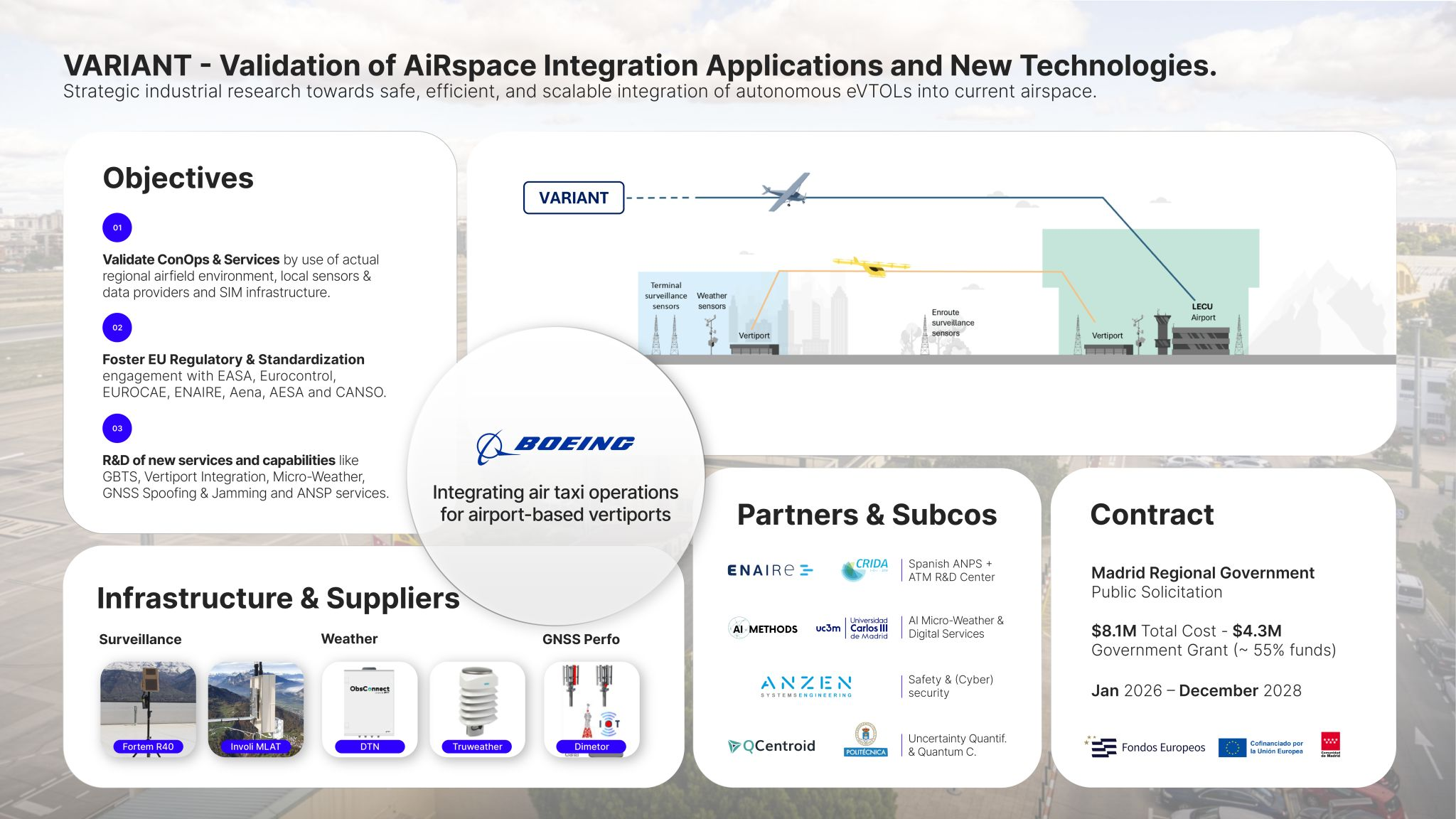
Simultaneously, QCentroid is contributing to the Boeing-led VARIANT project, which focuses on automated air traffic management for electric vertical takeoff and landing (eVTOL) aircraft. QCentroid’s QuantumOps framework acts as a foundational execution layer, allowing engineers to benchmark hybrid computational models across CPUs, GPUs, and quantum hardware backends in an auditable simulation environment. This project involves a specialized stack including atmospheric data from AI Methods, safety assurance from ANZEN Engineering, and fleet routing from Boeing subsidiary SkyGrid, demonstrating how quantum-inspired algorithms can complement classical machine learning to prevent network congestion.
Summary generated by RabbitReport AI from public reporting. The full article and original reporting belong to Quantum Computing Report.