International Federation of Robotics Identifies Top Five Trends for 2026
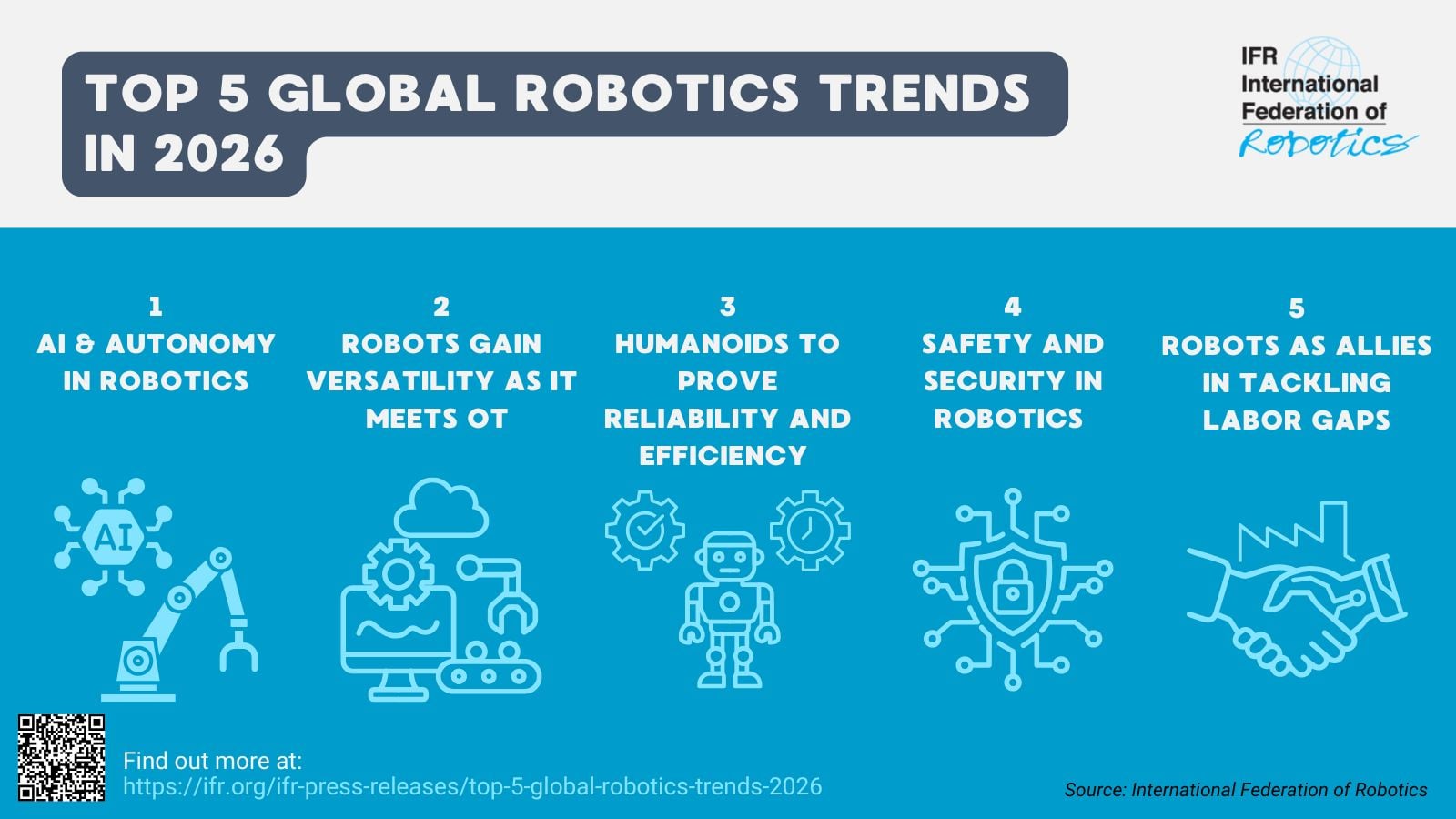
The International Federation of Robotics (IFR) has identified five key trends expected to shape the industry through 2026, centering on the advancement of AI-driven autonomy and the industrialization of humanoid robots. These developments reflect a broader push toward the convergence of Information Technology (IT) and Operational Technology (OT) to enhance versatility and real-time data exchange within smart factories. As robots become more integrated into human environments, the sector must address critical challenges regarding cybersecurity, safety standards, and the global shortage of specialized labor.
The IFR reports that robot autonomy is being transformed by a combination of analytical, generative, and agentic AI. Analytical AI enables robots to process large datasets for predictive maintenance and logistics planning, while generative AI allows for autonomous task learning and natural language interaction. Agentic AI represents a hybrid approach, merging structured decision-making with adaptability to help robots navigate complex, real-world environments independently. This technological shift is supported by the convergence of IT and OT, which integrates data-processing power with physical control to facilitate the digital enterprise and Industry 4.0.
Humanoid robots are moving beyond the prototype stage toward real-world deployment in the automotive and warehousing industries. To compete with traditional automation, these robots must achieve human-level dexterity while meeting strict industrial requirements for cycle times, energy efficiency, and maintenance costs. The increasing use of AI and cloud-connected systems, however, necessitates a focus on safety and cybersecurity. The IFR notes a rise in hacking attempts targeting robot controllers and emphasizes that systems must be designed in accordance with ISO safety standards and clear liability frameworks to manage the "black box" nature of deep learning models.
The global struggle to find skilled labor is a primary motivator for the adoption of robotics and automation. By taking over routine tasks and filling labor gaps, robots can reduce staff stress and make industrial workplaces more appealing to younger workers. The IFR stresses that successful automation depends on close cooperation with the human workforce to ensure acceptance and the implementation of skilling and upskilling programs. These initiatives are essential for helping workers adapt to an automation-driven economy and ensuring that robots are viewed as allies in the workplace rather than replacements.
Summary generated by RabbitReport AI from public reporting. The full article and original reporting belong to IFR International Federation of Robotics.