Meal Kit Delivery Services Market Size, Share | Industry [2034]
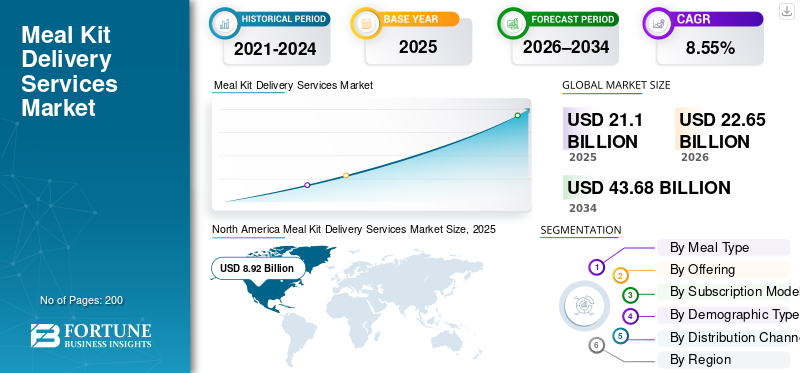
The global meal kit delivery services market is projected to reach a valuation of $43.68 billion by 2034, growing at a compound annual growth rate of 8.55%. This expansion is primarily driven by the increasing demand for time-efficient, nutritionally balanced dining solutions among urban, dual-income households. As the sector matures, the shift toward health-conscious offerings and ready-to-eat formats is becoming essential for maintaining market share in a competitive landscape.
The global meal kit delivery services market was valued at $21.10 billion in 2025 and is expected to grow to $43.68 billion by 2034, with North America currently leading the sector with a 42.27% market share. Major industry participants including HelloFresh SE, Blue Apron Holdings, Inc., Marley Spoon AG, Gousto Group Ltd., and Home Chef (Kroger Co.) collectively hold a significant portion of the market. These players are leveraging scale and logistics capabilities to meet the rising demand for both ready-to-cook and ready-to-eat meal solutions, which are increasingly favored by time-constrained professionals and single-person households.
Within the market segments, ready-to-cook kits dominated in 2025 with a $14.28 billion valuation, while the ready-to-eat category is projected to be the fastest-growing segment with a 9.83% CAGR. Non-vegetarian options accounted for $11.30 billion in 2025, but health-focused kits—covering keto, low-carb, and allergen-free diets—are seeing rapid growth at a 9.31% CAGR. Demographic shifts are also evident, as the household segment led with $12.59 billion in 2025, while the individual segment is expected to expand at 9.60% annually due to the rise of urban professionals and students.
The subscription-based model remains the core revenue driver, valued at $15.64 billion in 2025, providing companies with predictable demand and improved supply chain efficiency. Direct-to-consumer (DTC) channels also lead distribution, valued at $14.55 billion, allowing for better data ownership and brand control. To sustain growth, providers are investing in centralized kitchens and chilled logistics, though they must navigate challenges related to premium pricing. According to the Food and Agriculture Organization, affordability remains a barrier in price-sensitive regions like Asia and South America, where high costs restrict adoption among lower-income populations.
Summary generated by RabbitReport AI from public reporting. The full article and original reporting belong to Fortune Business Insights.