Apparel Market Size, Share, Future Trends & Forecast, 2034
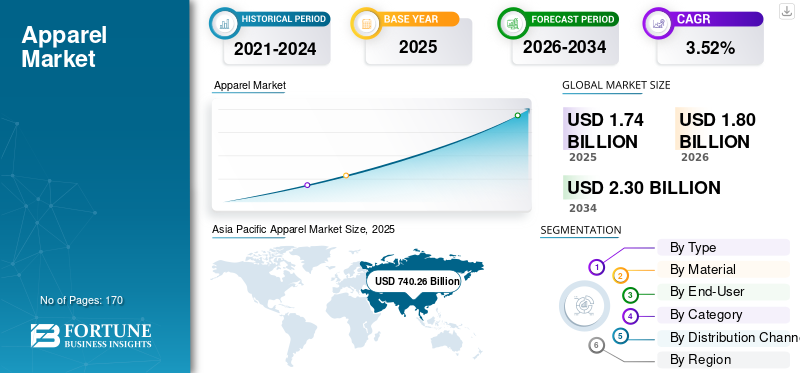
The global apparel market is poised for steady growth, with its valuation expected to rise from $1,749.67 billion in 2025 to over $2,307 billion by 2034. This expansion is fueled by the rise of the middle class in emerging economies, the continued dominance of fast fashion, and a significant pivot toward omnichannel retail. For the fashion sector, these figures underscore a robust recovery from pandemic-era disruptions and a strategic shift toward digital transformation and supply chain resilience.
The global apparel industry is exhibiting a compound annual growth rate (CAGR) of 3.52%, driven largely by the Asia Pacific region, which held a dominant 41.03% market share in 2025 with $740.26 billion in revenue. North America and Europe follow as the next largest markets, valued at $466.78 billion and $432.30 billion respectively in 2025. Growth in these regions is supported by increasing disposable incomes and the expansion of the working population, particularly in emerging economies like India, where labor force participation rose from 49.8% to 57.9% by 2023. While the COVID-19 pandemic previously caused a 30% market contraction—noted by retailers like Harry Rosen due to the mass closure of public spaces—the industry is now rebounding as consumer spending on clothing as a form of entertainment increases.
Fast fashion remains a primary growth engine, with industry leaders Zara and H&M leveraging rapid product lifecycles and product lifecycle management (PLM) to meet consumer demand for trendy styles at high frequencies. This model is being augmented by digital transformation, as e-commerce platforms become preferred distribution channels, allowing brands to engage directly with consumers and improve margins. However, this shift has also intensified competition and forced companies to prioritize supply chain resilience. To mitigate disruptions in global logistics and raw material sourcing, many apparel firms are diversifying their manufacturing bases and investing in nearshoring strategies to maintain agility in a volatile macroeconomic environment.
Sustainability has transitioned from a niche concern to a central pillar of the industry, particularly for Millennial and Gen Z consumers who demand transparency regarding material origins and labor practices. Brands are responding by adopting circular fashion models, which include recycling programs, repair services, and resale channels, as seen with initiatives from Levi’s and H&M. High-end players are also participating; for example, LVMH-owned Loro Piana launched the "Loro" capsule collection in 2023, utilizing recycled cashmere surpluses for a range of sizes. This shift toward ethical fashion and eco-friendly materials is becoming a key competitive differentiator, as consumers show an increasing willingness to pay a premium for purpose-driven brands that align with their environmental values.
Summary generated by RabbitReport AI from public reporting. The full article and original reporting belong to Fortune Business Insights.