Virtual Reality in Education Market Size, Share | Growth [2034]
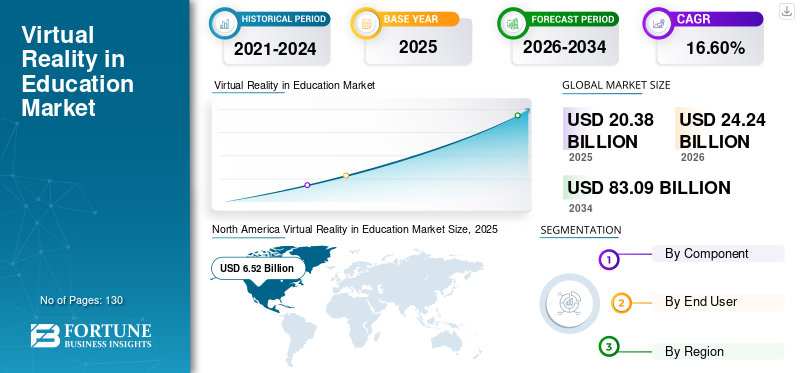
The global virtual reality in education market is set for explosive growth, with its valuation expected to rise from $20.38 billion in 2025 to $83.09 billion by 2034. This expansion is driven by a 16.60% CAGR and the increasing integration of generative AI to create personalized, adaptive learning environments. As educational institutions seek to overcome the limitations of traditional classrooms and address learning challenges like Attention Deficit Disorders, VR technology is becoming a vital tool for delivering cost-effective, hands-on experiential learning.
The global virtual reality in education market is entering a period of rapid acceleration, with a projected compound annual growth rate (CAGR) of 16.60% through 2034. North America currently leads the sector, holding a 32.00% market share in 2025, while the U.S. market alone is expected to reach $11.36 billion by 2032. This expansion is fueled by the transition from standard instructional methods to immersive 3D simulations that allow students to interact with objects and make decisions in realistic virtual worlds. The shift was significantly catalyzed by the COVID-19 pandemic, which forced institutions to adopt VR-based solutions to replicate the interactive and experiential aspects of in-person learning during remote periods.
A major catalyst for future growth is the convergence of virtual reality and generative AI, which creates dynamic, multi-sensory environments that adapt to individual student performance in real-time. This synergy allows for the creation of customized VR content and difficulty levels, providing continuous guidance and fostering skill mastery. Notable industry developments include the January 2024 partnership between Engage and Lenovo’s ThinkReality VRX, aimed at democratizing XR development through generative AI. Additionally, major platforms like Coursera have entered the space, launching three courses in VR technology in April 2023 to enhance student engagement alongside Meta’s augmented reality technologies.
Beyond technological advancement, VR is addressing critical pedagogical challenges such as Attention Deficit Disorders (ADD) and the limitations of traditional classroom settings. By facilitating experiential learning, VR enables students to participate in laboratory experiments, technical projects, and global field trips that would otherwise be cost-prohibitive or physically inaccessible. These platforms support personalized learning paths where students can navigate environments at their own pace and receive immediate feedback. This shift toward active learning and critical thinking empowers students to take ownership of their education while providing educators with more sophisticated, data-driven assessment tools to evaluate knowledge and skills comprehensively.
Summary generated by RabbitReport AI from public reporting. The full article and original reporting belong to Fortune Business Insights.