Dental Services Market Size, Share | Global Report [2026-2034]
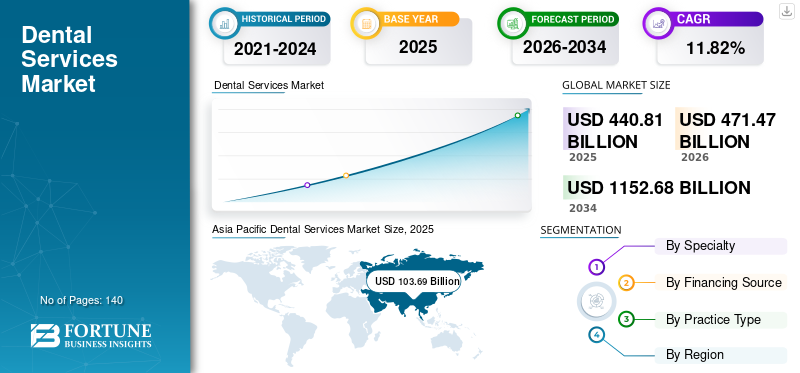
The global dental services market is poised for significant expansion, with its valuation expected to rise from $440.81 billion in 2025 to over $1.15 trillion by 2034. This growth, representing a compound annual growth rate of 11.82%, is primarily driven by the increasing prevalence of dental disorders such as caries and gum infections alongside rapid technological advancements like laser dentistry. For the dental industry, these figures underscore a robust demand for both preventative and specialized care, even as high procedure costs and limited insurance coverage remain key challenges for patient adoption.
The market's upward trajectory is supported by strong regional performances, particularly in North America, which generated $176.83 billion in 2025 and is expected to reach $189.71 billion by 2026. Europe and the Asia Pacific region also show substantial activity, with Asia Pacific holding a 23.52% market share in 2025 and projected to grow to $111.39 billion by 2026. This global expansion is fueled by shifting lifestyle factors, including increased urbanization and the consumption of high-sugar diets, which have led to a higher incidence of tooth decay, misaligned teeth, and periodontal infections.
General dentistry is set to remain the dominant specialty, projected to hold a 31.84% market share in 2026 as patients focus on routine checkups, teeth whitening, and preventative care. Meanwhile, the solo practice model continues to lead the industry with a projected 61.36% share in 2026, though Dental Service Organizations (DSOs) and group practices are gaining traction. Young professionals are increasingly drawn to the DSO model to mitigate administrative burdens and laboratory costs, a trend further accelerated by strategic mergers and acquisitions within the sector. Other segments, including orthodontics and oral & maxillofacial surgery, are also seeing growth due to rising demand for reconstructive procedures and corrective treatments.
Despite the market's growth, financial barriers persist, as evidenced by the out-of-pocket segment accounting for a dominant 61.85% share of financing in 2026. High capital requirements for dental equipment and maintenance often result in increased service fees, which, combined with limited reimbursement for cosmetic procedures, can hinder patient access. Data from the CDC highlighting that more than one in four U.S. adults have untreated tooth decay emphasizes the ongoing struggle between high-cost specialized services and the need for affordable healthcare. Industry growth is further influenced by the adoption of intraoral cameras and laser dentistry, which improve diagnostic accuracy but contribute to the overall cost of care.
Summary generated by RabbitReport AI from public reporting. The full article and original reporting belong to Fortune Business Insights.