Cybersecurity Market Size, Share, Analysis | Global Report 2034
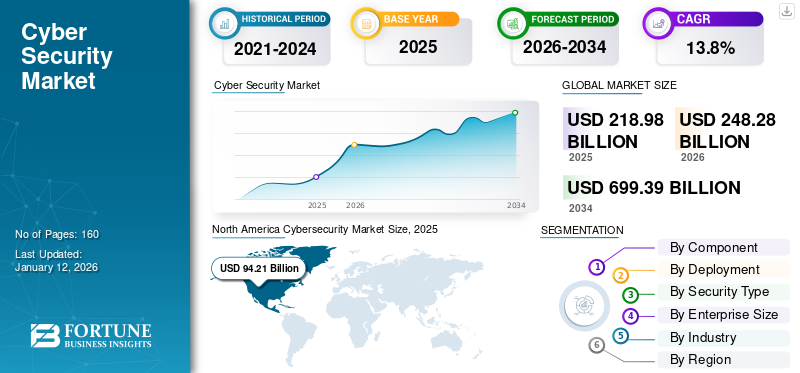
The global cybersecurity market is projected to grow from $218.98 billion in 2025 to $699.39 billion by 2034, representing a compound annual growth rate of 13.8%. This expansion is primarily driven by the increasing adoption of enterprise security solutions across the manufacturing, healthcare, and BFSI sectors as digital infrastructures become more complex. As organizations transition to cloud-based models and integrate generative AI, the industry is shifting toward advanced threat detection and automated risk management to combat sophisticated cyberattacks.
The global cybersecurity market is expected to reach $699.39 billion by 2034, up from $218.98 billion in 2025, with North America currently holding a dominant 43.0% market share. Key industry participants, including IBM Corporation, Microsoft Corporation, Palo Alto Networks, and Broadcom, are focusing on expanding their product portfolios to address the rising frequency of malware, phishing, and DDoS attacks. This growth is underpinned by a 13.8% CAGR, as organizations in the BFSI and healthcare sectors increasingly prioritize the protection of sensitive information and business processes.
Generative AI is emerging as a transformative force in the sector, utilizing neural networks and models like Generative Adversarial Networks to enhance threat detection and create complex encryption keys. These AI-driven tools provide an extra layer of security by producing unique passwords and refining data accuracy through constant feedback loops. Additionally, the shift toward cloud computing is enabling businesses to move core functions to secure platforms, leveraging Software-Defined Perimeters (SDP) and Analytics as a Service (AaaS) to identify and mitigate risks more rapidly than traditional network security solutions.
The market is bifurcated into solutions and services, with the solutions segment—which includes Identity and Access Management (IAM), firewalls, and Security Information and Event Management (SIEM)—projected to account for 61.73% of the market by 2026. While solutions currently dominate, the services segment is anticipated to witness the highest CAGR due to the increasing complexity of multi-cloud and hybrid IT environments. This complexity often exceeds the capabilities of internal teams, driving demand for external expertise in incident response, compliance, and risk management.
Despite the positive outlook, the market faces significant restraints, such as a shortage of cybersecurity professionals and the high costs associated with implementing and updating advanced security infrastructure. These financial barriers particularly impact Small & Medium Enterprises (SMEs), which may struggle to keep pace with evolving threats. To counter these challenges, vendors are increasingly integrating machine learning and IoT technologies to develop signature-less security systems that can detect uncertain activities and potential breaches across expanding digital infrastructures.
Summary generated by RabbitReport AI from public reporting. The full article and original reporting belong to Fortune Business Insights.