Consumer Electronics Market Size, Share, Trends, Growth, 2034
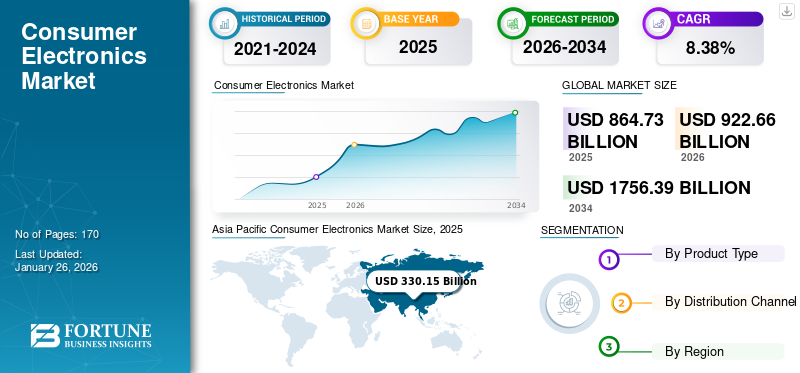
The global consumer electronics market is poised for significant expansion, with its valuation expected to grow from $864.73 billion in 2025 to over $1.75 trillion by 2034. This growth is driven by a steady 8.38% CAGR, fueled by the rising adoption of smart home technologies and the increasing digitalization of modernized households. For the consumer electronics sector, these trends highlight a shift toward high-performance, connected devices and a growing emphasis on sustainable, energy-efficient manufacturing.
The market's upward trajectory is underpinned by strong regional performance and evolving consumer preferences for both miniaturized components and large-format displays. Asia Pacific remains the dominant force, capturing a 38.18% market share in 2025, while the electronic devices segment—including TVs, computers, and tablets—is forecast to hold 58.33% of the market by 2026. Industry leaders are responding to these shifts with targeted innovations, such as LG Electronics' expansion into Mini LED and OLED panels and Canon’s launch of high-end mirrorless cameras like the EOS R3.
The integration of smart technology and the Internet of Things (IoT) is a primary catalyst for market evolution, as evidenced by the rising demand for appliances featuring voice assistance and wireless connectivity. Companies like boat are collaborating with technology providers to launch smart speakers, while the broader industry is pivoting toward eco-friendly products to meet consumer demand for sustainability. This technological shift is further supported by government initiatives, particularly in India, where the electronics manufacturing and export market is projected to reach $300 billion by 2025-26, fostering the development of 5G, AI, and machine learning applications.
Despite the optimistic outlook, the sector faces challenges related to economic disparities and infrastructure limitations in developing regions. For instance, smart home technology penetration in Malaysia remains at 12.2%, trailing significantly behind the global average and developed markets like the U.S. and South Korea. Additionally, while the COVID-19 pandemic initially disrupted supply chains, it permanently altered the landscape by boosting demand for remote work tools, with LG reporting significant revenue share increases for monitors and tablets during the height of the crisis. Distribution also remains heavily weighted toward offline channels, which are expected to account for 70.20% of the market in 2026 due to consumer preference for in-person product testing.
Summary generated by RabbitReport AI from public reporting. The full article and original reporting belong to Fortune Business Insights.