Machine Vision Market Size to Surpass USD 76.89 Billion by 2035
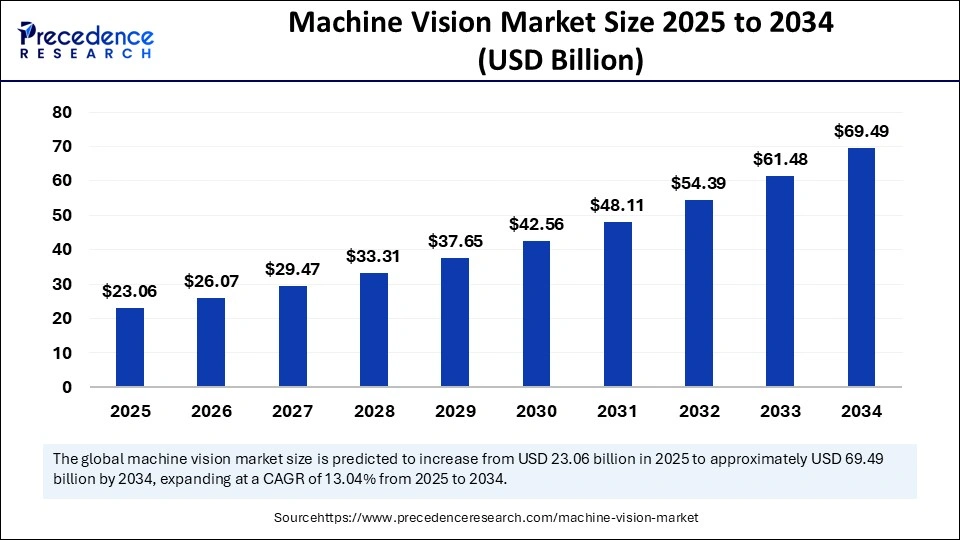
The global machine vision market is projected to grow from $23.06 billion in 2025 to nearly $76.89 billion by 2035, driven by a compound annual growth rate of 12.80%. This expansion is primarily fueled by the increasing industrial demand for automated quality inspection and the integration of advanced artificial intelligence to enhance pattern recognition and defect detection. The sector is seeing significant diversification beyond manufacturing into healthcare, agriculture, and augmented reality, marking a critical shift in how visual data drives operational decision-making.
The machine vision sector is poised for significant expansion, with its market valuation expected to more than triple over the next decade, rising from $23.06 billion in 2025 to $76.89 billion by 2035. While hardware components like image sensors, cameras, and processing units currently dominate the market, the software segment is anticipated to experience the fastest growth due to the integration of machine learning and AI algorithms. These technological advancements allow systems to adapt to environmental changes such as lighting and texture, significantly improving the accuracy of tasks like object recognition and visual inspection across industries including electronics, automotive, and food and beverage.
Recent financial activities and corporate strategies highlight the sector's momentum and its underlying challenges. For instance, the Italian startup Focoos AI, a spin-off of Politecnico di Torino, recently secured a €2.65 million seed investment round led by Galaxia to advance its technology. However, the rapid democratization of deep learning has created a substantial talent gap for skilled professionals, which currently acts as a major challenge to market growth. To mitigate this hurdle, industry giants like Google and Amazon are investing internationally to expand their talent pools and support the development of increasingly complex vision applications.
Application-wise, the automotive industry remains the primary market leader as of 2025, utilizing machine vision for driver assistance systems, lane tracking, and autonomous vehicle perception. Meanwhile, the pharmaceuticals and chemicals segment is identified as the fastest-growing vertical due to stringent regulatory requirements for label verification and packaging integrity. From a technical standpoint, PC-based systems currently lead in market share due to their high processing power and adaptability, though smart camera-based systems are gaining ground rapidly thanks to their built-in processing capabilities and improved efficiency in automation.
Summary generated by RabbitReport AI from public reporting. The full article and original reporting belong to Precedence Research.