AI In Chemicals Market Size, Share | CAGR of 27.3%
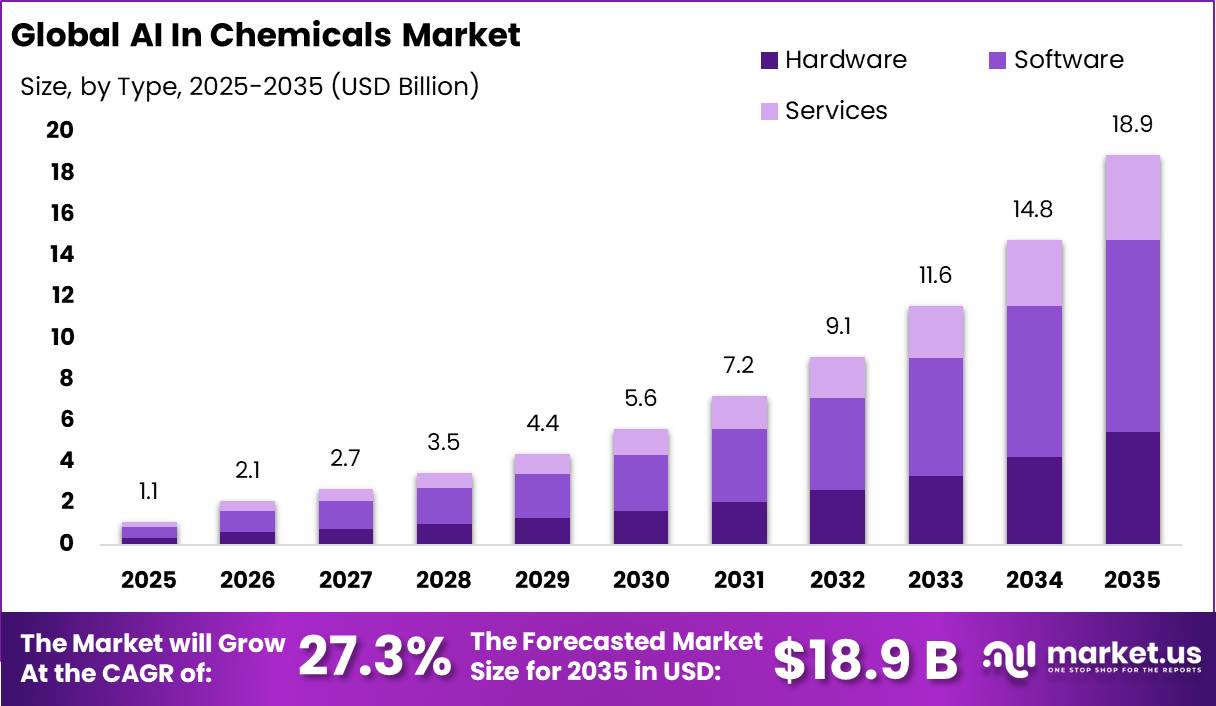
The global AI in chemicals market is set for explosive growth, expanding from $1.1 billion in 2025 to an estimated $18.9 billion by 2035 as producers transition from pilot projects to plant-scale machine learning and generative AI applications. This shift is primarily motivated by the need to address margin pressures, energy volatility, and stringent sustainability targets across the global industrial base. The adoption of these digital productivity tools is becoming a strategic necessity for the sector, which supports significant portions of GDP in major economies like the United States and China.
The rapid expansion of AI within the chemical sector is reflected in rising adoption rates, with OECD data showing that 20.2% of firms utilized AI in 2025, up from just 8.7% in 2023. North America currently maintains a dominant market position, capturing over 42.70% of the share in 2025 with $0.4 billion in revenue. This growth is occurring against a backdrop of economic challenges, such as a 2.3% decrease in EU27 chemical sales value reported by Cefic, which has intensified the need for AI-driven efficiency. In the United States, where chemistry supports roughly 25% of the GDP and records $38.9 billion in annual capital investment, companies are increasingly allocating funds toward instrumentation, computers, and automation to modernize their operations.
Segment analysis reveals that software solutions held a 49.20% market share in 2025, as chemical manufacturers prioritize AI-powered platforms for research, quality monitoring, and process management. Production optimization stands as the leading application, accounting for 32.80% of the market, driven by the use of intelligent systems to monitor real-time conditions and maximize output. Furthermore, the specialty chemicals end-use segment captured 27.90% of the market, as firms leverage AI to improve formulation accuracy and accelerate the innovation cycles required for advanced precision manufacturing. These technologies are being integrated into R&D and supply-chain planning to mitigate the impacts of skilled-labor shortages and weak demand.
Institutional and corporate activities are further catalyzing the market's evolution. The European Commission’s InvestAI initiative has targeted €200 billion for AI development, including the establishment of AI gigafactories to support industrial research. In the private sector, Honeywell made a significant move in May 2025 by agreeing to acquire Johnson Matthey’s Catalyst Technologies business for £1.8 billion, while also partnering with Nutanix to provide virtualization for its Experion PKS automation systems. Beyond productivity, the International Energy Agency (IEA) highlights that AI applications could help the industry reduce CO2 emissions by 1,400 Mt by 2035, aligning digital transformation with global decarbonization goals.
Summary generated by RabbitReport AI from public reporting. The full article and original reporting belong to Market.us.