Personalized Medicine Market Size, Share | Growth Report[2034]
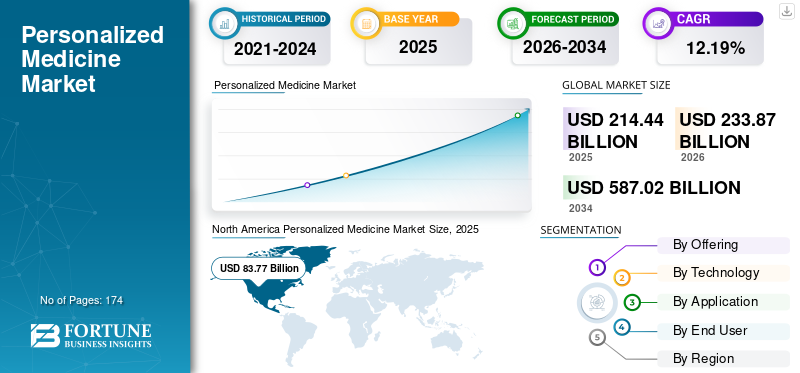
The global personalized medicine market is valued at $214.44 billion in 2025 and is projected to reach $587.02 billion by 2034, growing at a CAGR of 12.19%. This growth is primarily fueled by the increasing adoption of companion diagnostics, genomic testing, and biomarker-driven targeted therapies that enhance disease identification and treatment oversight. For the genomics and precision medicine sector, these trends represent a fundamental shift toward data-driven healthcare that prioritizes individual patient profiles over universal treatment models.
The global personalized medicine market is forecast to expand significantly, with North America maintaining a dominant position after capturing a 39.11% market share in 2025. Key industry players such as F. Hoffmann-La Roche Ltd, Myriad Genetics, Inc., Thermo Fisher Scientific Inc., and AstraZeneca are driving innovation through extensive genomic profiling, liquid biopsy, and AI-driven clinical decision support tools. These organizations are focusing on integrated molecular data platforms and pharmacogenomics to streamline therapy matching and precision oncology processes, reflecting a broader industry move toward research-driven drug development.
The shift toward targeted therapies is a defining trend, as treatments are increasingly tailored to specific biomarkers and protein expression patterns to improve clinical results and reduce exposure to ineffective therapies. This evolution is supported by the rising incidence of chronic and genetic conditions, including cancer, cardiovascular diseases, and rare disorders, which necessitate earlier diagnosis and more customized risk assessments. As genomic screening and sequencing technologies become more accessible, healthcare systems and biopharma firms are allocating more resources to validate new precision instruments and expand the application of personalized medicine beyond oncology into neurology and cardiology.
However, the sector must navigate substantial obstacles, most notably the high cost of targeted biologics and cell and gene therapies, which can strain healthcare budgets and hinder patient access. The OECD has highlighted that rising oncology drug costs are a major concern for even affluent health systems, potentially slowing market penetration despite strong clinical demand. Additionally, the sensitive nature of genomic data presents significant privacy and cybersecurity challenges, requiring companies to implement enhanced governance and consent management systems to maintain patient trust and comply with international data controls.
Summary generated by RabbitReport AI from public reporting. The full article and original reporting belong to Fortune Business Insights.