UK Water Treatment System Market Projected to Reach $72.5 Billion by 2036
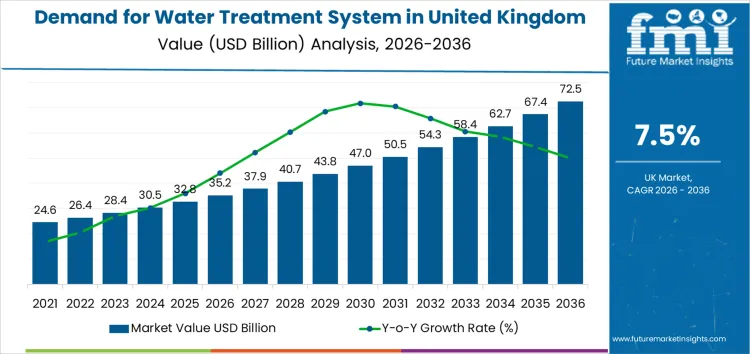
The United Kingdom's water treatment system market is poised for significant expansion, with valuations expected to more than double from USD 35.2 billion in 2026 to USD 72.5 billion by 2036. Driven by a compound annual growth rate of 7.5%, the sector is responding to tightening environmental regulations and an urgent need for infrastructure modernization. This growth underscores a critical shift toward advanced filtration technologies and sustainable resource management across municipal and industrial applications.
The UK water treatment market is entering a decade of robust growth, characterized by a 7.5% CAGR that will see the industry reach USD 50.5 billion by 2031 before hitting the USD 72.5 billion mark in 2036. Municipal water treatment currently stands as the primary application, commanding a 45% market share, while Reverse Osmosis technology is expected to dominate the technical landscape with a 35% share. Large-scale established players are maintaining their market position through significant capital investment and specialized expertise, creating high barriers to entry for smaller competitors despite a persistent demand for niche, customized solutions.
Regulatory evolution is a primary catalyst for this demand, as authorities implement stricter standards regarding contaminants like microplastics, nitrates, and heavy metals. This has forced a transition from conventional filtration to more sophisticated systems in both the public and private sectors. Industrial users in the pharmaceutical, chemical, and food and beverage sectors are increasingly adopting closed-loop systems and deionization units to protect high-precision equipment and ensure product integrity. Furthermore, the need to treat industrial effluent to meet stringent environmental compliance criteria is driving the adoption of tailored wastewater solutions.
Looking toward the 2030s, the market will be shaped by a focus on operational resilience and resource optimization. Water-intensive industries such as horticulture are seeking systems that improve recovery and reuse rates to mitigate the risks of fluctuating energy prices and water scarcity. Additionally, the aging state of existing municipal infrastructure presents a major opportunity for suppliers of modular and scalable technologies that can be retrofitted into current assets. Innovations in digital monitoring, automated controls, and membrane technology are expected to provide further value by enabling predictive maintenance and reducing long-term lifecycle costs for procurement teams.
Summary generated by RabbitReport AI from public reporting. The full article and original reporting belong to Future Market Insights.