AI in Telehealth & Telemedicine Market Size, Share, Growth 2034
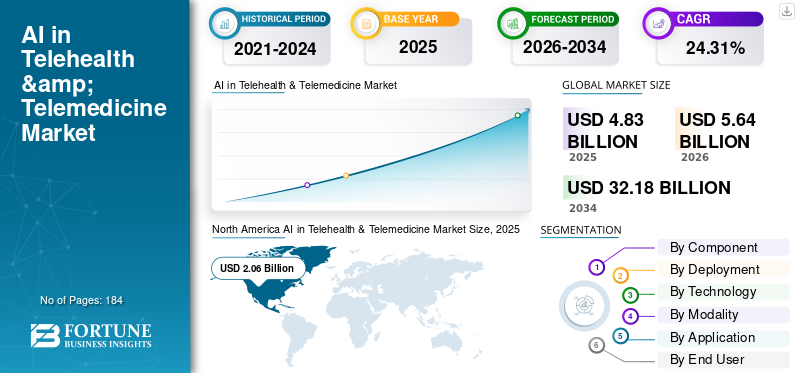
The global AI in telehealth and telemedicine market is projected to reach $32.18 billion by 2034, growing at a compound annual growth rate of 24.31%. This expansion is driven by a critical need to address a projected global shortage of 11 million health workers by 2030 and the rising prevalence of chronic conditions. As the sector matures, AI is being integrated into virtual care platforms to automate administrative tasks, enhance remote patient monitoring, and improve clinical throughput.
The global AI in telehealth and telemedicine market was valued at $4.83 billion in 2025 and is expected to climb to $32.18 billion by 2034, with North America currently holding a dominant 42.65% market share. Major players like Teladoc Health, Amwell, Included Health, and Microsoft are leading the charge by integrating AI into platforms that handle patient intake, ambient documentation, and operational insights. These tools are becoming essential as healthcare systems face a projected World Health Organization workforce shortage of 11 million by 2030, forcing a redesign of care models to rely more on automation for non-clinical tasks and triage.
A major trend in the sector is the evolution of Remote Patient Monitoring (RPM) from simple data collection to predictive care using machine learning algorithms. These models analyze high-frequency vital signs to identify subtle health declines earlier, which helps prioritize clinician intervention and reduces the frequency of false alerts. This technology is enabling the expansion of virtual wards and hospital-at-home programs, allowing providers to manage higher-acuity patients outside of traditional facilities. The shift toward these continuous monitoring models is also driving higher recurring software and analytics revenues for technology vendors.
Despite the growth, the market faces challenges such as regulatory ambiguity regarding medical device classification and the need for rigorous clinical validation. Uncertainty in these areas can delay product launches and complicate cross-border compliance, particularly when standards for data governance and transparency differ between regions. Additionally, the lack of reliable digital infrastructure in rural areas remains a significant hurdle, as poor connectivity can diminish the efficacy of AI-driven evaluations. However, increased investor funding for AI healthcare startups is helping to bridge these gaps, transforming pilot projects into scalable, enterprise-level applications that integrate with existing electronic health records.
Summary generated by RabbitReport AI from public reporting. The full article and original reporting belong to Fortune Business Insights.