UCF Scientist Develops New Approach to Reduce Quantum Computing Errors
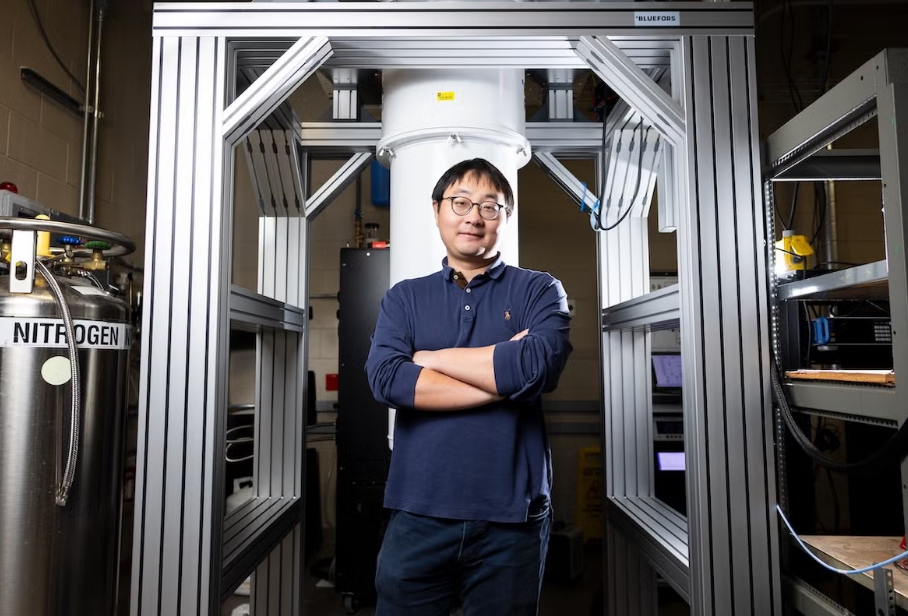
Assistant Professor Han Zhao at the University of Central Florida is developing a novel method to mitigate quantum computing errors by integrating superconducting systems with nanomechanical devices. Supported by the Ralph E. Powe Junior Faculty Enhancement Award, the research aims to create a topological braiding process that makes quantum operations inherently resistant to environmental noise. This approach could significantly advance the practicality of quantum computers by protecting fragile quantum states without the massive hardware overhead typically required for traditional error correction.
The research, led by UCF Assistant Professor of Physics Han Zhao, addresses the fundamental challenge of quantum decoherence caused by environmental factors like temperature fluctuations, stray radio waves, and physical vibrations. Supported by the Oak Ridge Associated Universities Ralph E. Powe Junior Faculty Enhancement Award, the project provides seed funding for specialized superconducting quantum hardware and graduate student research. Zhao’s work leverages UCF’s existing infrastructure, including nanofabrication facilities and advanced waveform control systems, to conduct experiments at temperatures near absolute zero inside specialized dilution refrigerators.
Unlike standard quantum error correction (QEC) which requires substantial hardware resources to protect logical qubits using multiple physical qubits, Zhao’s approach focuses on making the operations themselves fault-tolerant through a process called topological braiding. This method utilizes microscopic vibrating structures known as nanomechanical resonators that interact with microwave signals within superconducting circuits. By controlling these interactions, the team aims to create a system where quantum states exchange properties in a stable, predictable pattern. Zhao compares this to tying a shoelace, where the resulting knot remains the same even if the specific movements of the strands vary slightly, allowing for significant wiggle room against noise and control imperfections.
The experiments are conducted in an ultra-stable environment where the system is cooled to a fraction of a degree above absolute zero to eliminate thermal noise that would otherwise disrupt delicate quantum behavior. By engineering specific interactions between superconducting circuits and mechanical resonators in an open quantum system, the research seeks to achieve high-fidelity quantum operations that do not rely on perfect microscopic control. This shift from total isolation to engineered interaction represents a strategic pivot in quantum hardware design. If successful, this methodology could accelerate the development of practical quantum computers for applications in drug discovery, advanced materials, and cleaner energy technologies by reducing the hardware burden of error mitigation.
Summary generated by RabbitReport AI from public reporting. The full article and original reporting belong to The Quantum Insider.