IoT for Public Safety Market Size to Hit USD 10.57 Billion by 2035
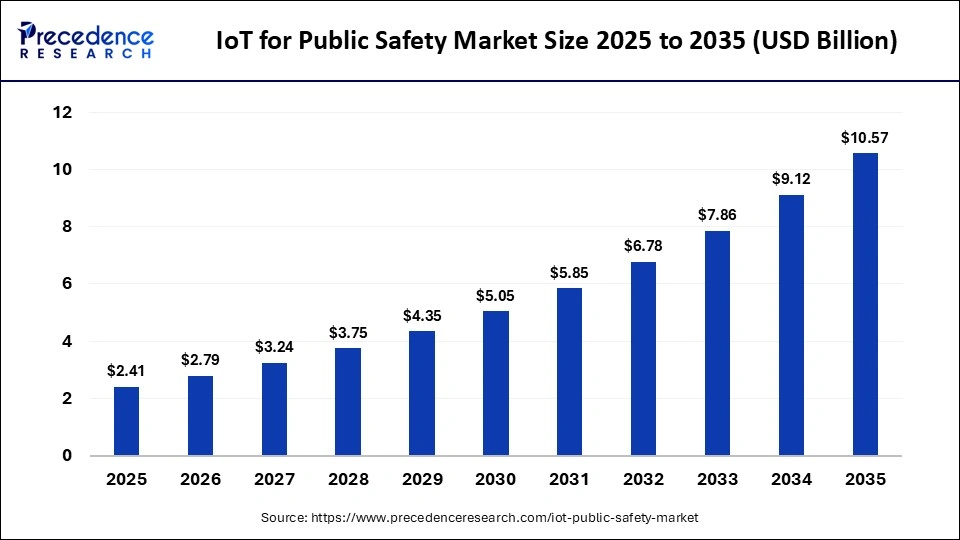
The global IoT for public safety market is projected to grow from USD 2.41 billion in 2025 to approximately USD 10.57 billion by 2035, representing a compound annual growth rate of 12.93%. This expansion is driven by the integration of artificial intelligence and data analytics, which facilitate the development of real-time, predictive public safety solutions. For the public safety technology sector, this trend underscores a critical shift toward smart city initiatives and the adoption of connected sensors to improve situational awareness and emergency response times.
The market is experiencing a significant transformation as artificial intelligence and data analytics are integrated into IoT systems to provide actionable insights for law enforcement and emergency responders. AI-driven surveillance cameras can now automatically identify weapons or unusual activities, while traffic sensors optimize routes to prevent accidents and improve public transportation safety. These technologies allow agencies to transition from reactive policing to proactive monitoring, utilizing predictive analytics to identify crime hotspots and allocate resources more effectively before incidents occur.
In 2025, the solutions segment dominated the market with a 72.7% share, reflecting a high demand for ready-to-deploy, integrated platforms that combine real-time surveillance, incident detection, and emergency coordination. Surveillance systems specifically led the technology category with a 32.4% share, as smart city projects increasingly require intelligent analysis over simple monitoring. Professional services also held a massive 72.5% share of the services market, as public safety agencies seek expert assistance for complex system integration, cybersecurity, and strategic planning to manage vast data streams.
Future growth is expected to be particularly strong in the disaster management segment, which is projected to expand at a CAGR of 10.9% due to the rising frequency of natural disasters. IoT sensors are being deployed to monitor the structural integrity of critical infrastructure like bridges and dams, providing early warnings for preventive maintenance. Additionally, the managed services segment is forecast to grow at a 10.8% CAGR as agencies look to outsource the management of complex IT infrastructures to specialized providers, allowing them to focus on core operations while reducing the need for large internal investments in hardware and specialized staff.
Summary generated by RabbitReport AI from public reporting. The full article and original reporting belong to Precedence Research.