US EIA forecasts declining oil prices as supply disruptions ease
The US Energy Information Administration (EIA) has revised its global oil price forecasts downward following a diplomatic breakthrough to reopen the Strait of Hormuz. A June 18 memorandum of understanding between the US and Iran is expected to restore critical transit flows that have been largely obstructed since February, significantly easing supply constraints. This shift is critical for the Oil & Gas sector as it signals a transition from a period of extreme price volatility and inventory draws toward a projected market oversupply by 2027.
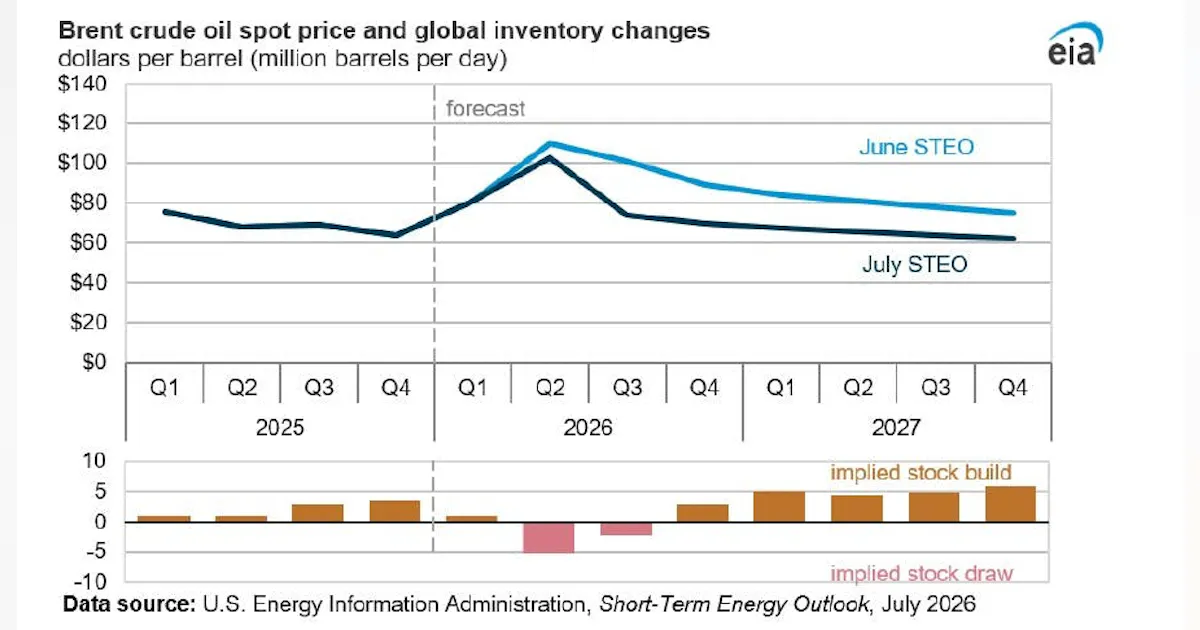
The US Energy Information Administration (EIA) reported in its July 7 Short-Term Energy Outlook that global oil prices are expected to decline as supply disruptions at the Strait of Hormuz are resolved. A memorandum of understanding signed between the US and Iran on June 18 effectively ended a conflict that had kept the critical transit chokepoint largely closed since February 28. Consequently, Brent crude prices, which peaked in April, fell to an average of $85/bbl in June and dropped below $70/bbl by July 1 as tanker traffic resumed and supply concerns eased.
The EIA anticipates that most shut-in crude production will return to near pre-conflict levels by the end of 2026, with a full restoration of flows projected for the first quarter of 2027. However, the market remains tight in the immediate term due to significantly depleted global inventories following a massive average draw of 5.1 million b/d in the second quarter of 2026. While another 2.2 million b/d draw is expected in the third quarter, much of the recent increase in tanker movement involves previously stranded cargoes rather than new production.
Looking ahead, the EIA forecasts a decline in global oil consumption by 1.2 million b/d in 2026, primarily due to an 0.8 million b/d drop in non-OECD demand within the Asia Pacific region. Demand is expected to recover in 2027, rising to 104.8 million b/d as prices stabilize. As supply growth begins to outpace this demand, inventories are projected to build by 2.7 million b/d in the fourth quarter of 2026 and by 5.0 million b/d throughout 2027. This shift toward oversupply has led the EIA to lower its Brent price forecast to $70/bbl for late 2026 and $65/bbl for 2027, noting that strategic stock replenishment may only partially offset the decline.
Summary generated by RabbitReport AI from public reporting. The full article and original reporting belong to Oil & Gas Journal.