AI in Oil and Gas Market Size, Share | CAGR of 13.8%
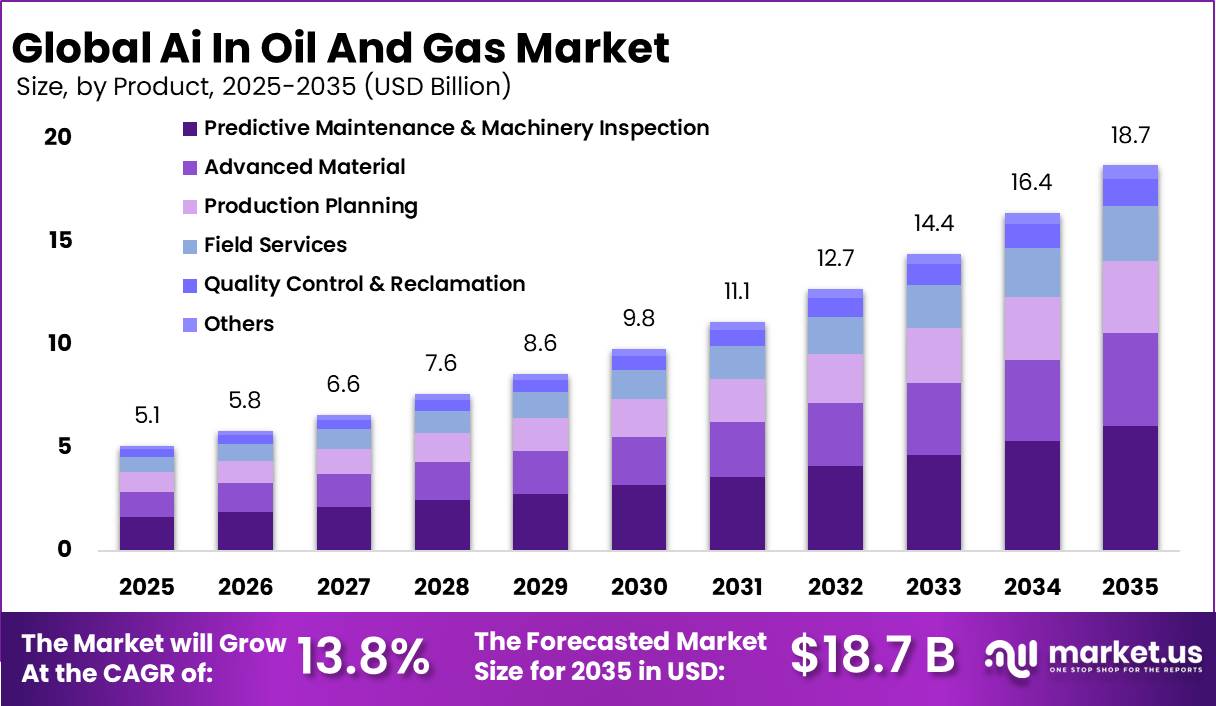
The global AI in oil and gas market is forecast to grow from $5.1 billion in 2025 to approximately $18.7 billion by 2035, representing a compound annual growth rate of 13.8%. This expansion is driven by a critical need for operational efficiency, methane emissions reduction, and the management of aging infrastructure across the upstream, midstream, and downstream sectors. As operators face tightening environmental regulations and volatile pricing, the integration of machine learning and predictive maintenance has become a strategic priority for 92% of industry enterprises.
The oil and gas industry is rapidly transitioning into a practical deployment phase for artificial intelligence, with 50% of sector executives already implementing AI-powered solutions to address business challenges. According to market data, the adoption of predictive maintenance alone saw a 28% increase in 2023, allowing companies to detect equipment issues before they cause costly breakdowns and downtime. Furthermore, AI integration in supply chain management and logistics resulted in a 12% reduction in operational costs in 2023 by optimizing routes and inventory management. Major industry players are solidifying this trend, as evidenced by C3.ai Inc. and Baker Hughes renewing their joint venture in May 2025 to accelerate AI transformation across the energy sector.
Environmental compliance and methane mitigation are significant catalysts for AI adoption, particularly as the IEA estimates that only 5% of global production currently meets near-zero emissions standards. To address this, the U.S. EPA and DOE have allocated $850 million to reduce methane pollution, while the Global Methane Pledge targets a 30% reduction by 2030. AI technologies, including satellite analytics and leak detection, are becoming essential tools for operators to meet these targets and comply with new EU regulations that impose methane intensity limits on crude oil and gas imports starting in 2030. These pressures are forcing a shift toward AI-enabled emissions control and asset integrity monitoring to manage nearly 3 million barrels per day of oil and 130 billion cubic meters of natural gas that require better oversight.
In terms of market composition as of 2025, hardware remains the dominant component with a 43.40% market share, driven by heavy investment in sensors, edge devices, and high-performance computing systems required for real-time data processing. Machine Learning (ML) stands as the leading technology segment, capturing 50.10% of the market as companies increasingly rely on data-driven decision-making for exploration and production. Within the product category, Predictive Maintenance & Machinery Inspection holds a 32.40% share, reflecting an industry-wide focus on improving equipment reliability and reducing the frequency of unplanned shutdowns in complex operational environments. These segments are supported by continued hydrocarbon demand, with the EIA projecting global demand to reach 105.6 million barrels per day by 2027.
Summary generated by RabbitReport AI from public reporting. The full article and original reporting belong to Market.us.