Nanotechnology in Medical Devices Market Projected to Reach USD 6.12 Billion by 2034
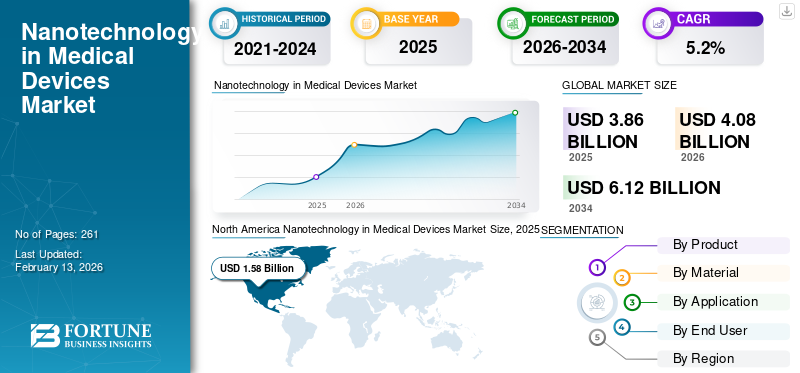
The global nanotechnology in medical devices market is valued at USD 3.86 billion in 2025 and is expected to reach USD 6.12 billion by 2034, growing at a CAGR of 5.2%. This expansion is primarily driven by the rising prevalence of chronic diseases and the increasing demand for minimally invasive procedures that require miniaturized, high-performance components. For the medical device sector, these advancements represent a critical shift toward personalized medicine and enhanced biocompatibility through nanoscale coatings and sensors.
The global market for nanotechnology in medical devices is experiencing steady growth, with North America leading the sector with a 40.93% market share in 2025. Major industry players, including Medtronic and Abbott, are increasingly integrating nanotechnology to enhance device functionality through sensing elements and specialized coatings. A significant trend in the industry is the use of surface nanomodification, which improves product efficiency and biocompatibility while reducing regulatory risks compared to launching entirely new systems. These nanostructured coatings are particularly effective in cardiovascular and implantable products, where they minimize bacterial adhesion and enhance long-term durability.
Market segmentation reveals that implantable devices held the largest revenue share in 2025, driven by the need for innovative solutions for chronic conditions. The therapeutic applications segment accounted for 60.1% of the market, supported by the demand for nano-enabled drug-eluting devices and localized therapy platforms, especially as heart attack rates remain high. In terms of materials, metal and metal-oxide components dominated with a 47.0% share due to their antimicrobial properties. However, the diagnostics and monitoring segment is projected to be the fastest-growing product category with a 6.0% CAGR, while carbon-based materials are expected to grow at a rate of 6.3% through 2034.
Despite the market's potential, significant hurdles remain regarding high development costs and stringent regulatory policies. The integration of nanomaterials requires advanced manufacturing facilities and extensive validation to address concerns such as nanoparticle migration and long-term toxicity. These requirements often lead to increased R&D expenses and extended innovation cycles. Nevertheless, the shift toward personalized medicine offers a major opportunity, as nano-enabled platforms and wearable sensors allow for real-time monitoring of biochemical markers. This enables proactive disease management and tailored patient care plans that minimize adverse reactions compared to traditional treatments.
The manufacturing of these devices presents its own set of challenges, particularly in scaling up production while maintaining quality. Because even small variances at the nanoscale can significantly alter a device's safety profile or performance, manufacturers must invest in multidisciplinary research and rigorous safety evaluations. Hospitals and ambulatory surgery centers (ASCs) remain the dominant end users of these technologies, as the increasing prevalence of chronic diseases necessitates the adoption of advanced, nano-enhanced surgical and diagnostic tools.
Summary generated by RabbitReport AI from public reporting. The full article and original reporting belong to Fortune Business Insights.