Japan BESS Market Surges as Energy Vault's 850 MW Entry Fuels Grid-Scale Buildout
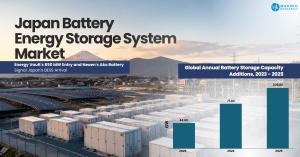
Japan’s battery energy storage system (BESS) market is entering a significant growth phase driven by rising renewable energy penetration and increasing solar curtailment. International developers and domestic trading houses are rapidly scaling project pipelines to address grid pressure, with global stationary storage deployment expected to reach 122.5 GW this year. This shift is supported by new regulatory frameworks and long-term auctions designed to improve the bankability of utility-scale storage assets.
International developers are aggressively expanding their presence in Japan, led by Energy Vault’s acquisition of an 850 MW BESS portfolio from BayWa r.e. This portfolio includes 350 MW of advanced-stage projects slated for construction in late 2027 and 500 MW of early-stage developments. Simultaneously, Neoen is entering the market with its 100 MW/400 MWh Ako Battery in Hyogo Prefecture, developed alongside Equans and Toho, while Eku Energy has advanced its fourth Japanese project, a 30 MW/120 MWh facility in Gunma Prefecture.
Domestic Japanese firms are transitioning from small-scale assets to utility-scale deployments, exemplified by a 230.1 MWh order from PowerX for a project in Fukuoka Prefecture involving Itochu Corporation and Tokyo Century. Trina Storage has also secured a contract for a 160 MWh ultra-high-voltage system in Kyushu, highlighting the move toward larger, high-capacity installations. Despite this momentum, the industry faces a significant gap between investor interest and physical infrastructure, with only 0.62 GW of BESS capacity currently connected to the grid compared to a much larger application pipeline.
The investment landscape is being bolstered by the Long-Term Decarbonization Auction (LTDA), which offers fixed 20-year revenue contracts; approximately 1.3 GW was awarded to 25 BESS projects in the FY2024 round alone. These policy mechanisms, including METI subsidies and the classification of projects over 10 MW as power generation businesses, are essential as Japan aims for renewables to provide up to 50% of its electricity by 2040. However, developers must navigate strategic dependencies on Chinese battery supply chains while managing evolving grid connection rules and charging capacity allocations.
Summary generated by RabbitReport AI from public reporting. The full article and original reporting belong to The National Law Review.