Germany’s battery production rebounds as industry warns of risks
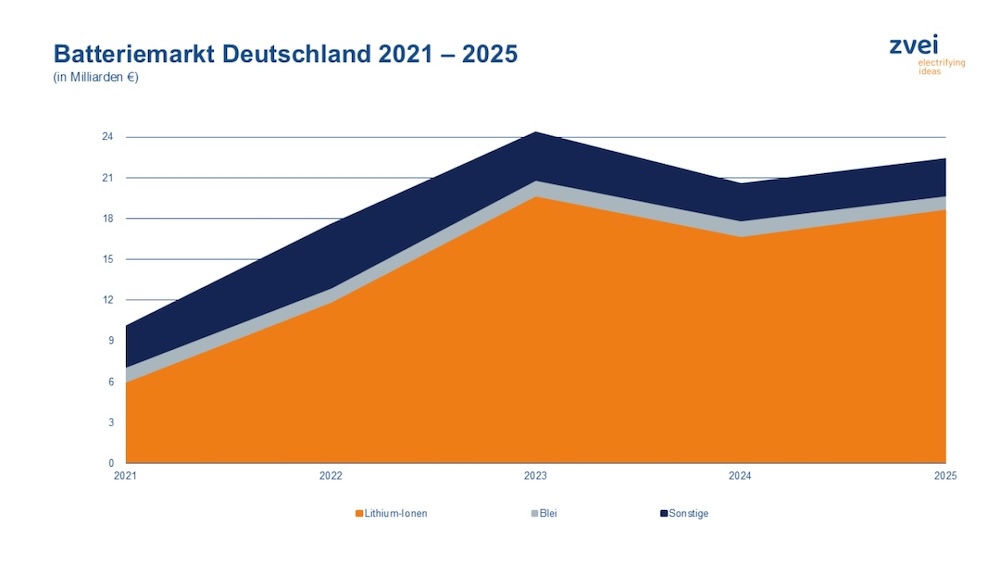
Germany’s battery industry saw a significant recovery in 2025, with lithium-ion production revenue increasing by 28% to €4.6 billion. This growth was primarily driven by the ramp-up of electric mobility and sustained demand for battery energy storage systems, pushing the total market volume to €22.4 billion. Despite these record production figures, industry association ZVEI warned that the sector remains heavily dependent on Asian supply chains, particularly for critical imports from China.
According to figures from the Verband der Elektro- und Digitalindustrie (ZVEI), Germany’s battery production reached a record €8.1 billion in 2025, representing an 11% increase across all chemistries. The lithium-ion segment was the primary driver of this rebound, growing 28% year-on-year to reach €4.6 billion ($5.3 billion) following a downturn in 2024. While the total domestic market volume of €22.4 billion remains slightly below the 2023 peak of €24.3 billion, the 9% expansion from 2024 levels signals a strong recovery fueled by electric vehicle manufacturing and the stationary energy storage sector.
The data highlights a growing reliance on foreign suppliers, as total battery imports rose 4% to approximately €22 billion. China remains Germany’s dominant supplier, with imports increasing 25% to €11 billion in 2025, while Hungary led European imports at €3.5 billion. In contrast, German export volumes fell by 2.5% to €7.8 billion, with a particularly sharp 34% decline in exports to Asian markets. ZVEI officials noted that 70% of exports remain within Europe, but the widening trade gap underscores the challenges of establishing a self-sufficient domestic ecosystem.
Gunther Kellermann, managing director of ZVEI’s battery division, warned that disruptions to Asian supply chains could jeopardize critical sectors such as defense and data centers. To mitigate these risks, the industry is calling for the realization of the EU’s Net Zero Industry Act target, which aims for 40% domestic battery cell production by 2030. Christian Rosenkranz, chairman of ZVEI’s battery division, emphasized the need for stronger investment incentives and trade tools to counter subsidized imports. Furthermore, the association is urging policymakers to provide lower electricity prices and more flexible energy market models to ensure the long-term competitiveness of German battery manufacturing.
Summary generated by RabbitReport AI from public reporting. The full article and original reporting belong to ESS News.