Oil Giant Shell Unveils Efficient New EV Concept
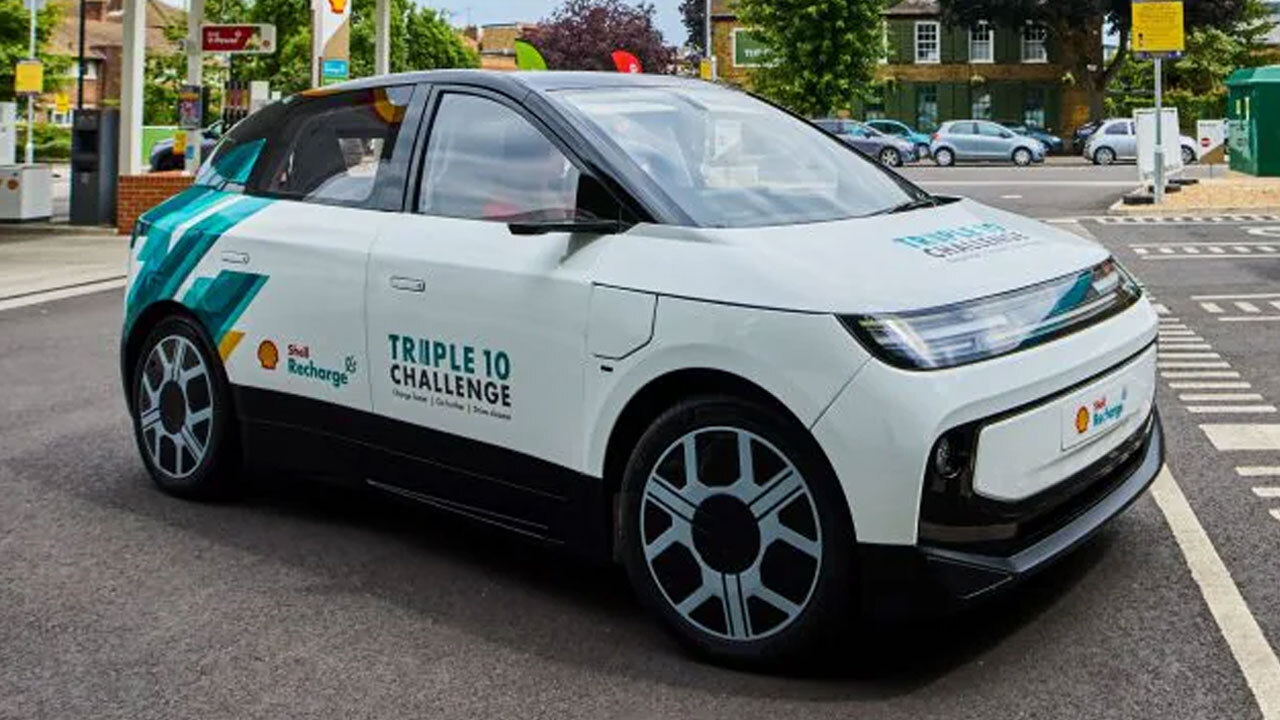
Shell has introduced the Triple 10 Challenge, a proof-of-concept electric vehicle designed to showcase extreme efficiency and rapid charging capabilities. The vehicle targets a 10-km/kWh efficiency rate and a sub-10-minute charging time for an 80% capacity boost, aiming to influence the design philosophy of next-generation battery electric vehicles. This project highlights the oil major's shift toward supporting EV infrastructure and thermal management technologies to address range and charging speed concerns in the sector.
Shell’s Triple 10 Challenge concept is a compact, five-door hatchback engineered to meet three specific performance benchmarks: achieving 10 kilometers per kilowatt-hour (approximately 6.2 miles/kWh), maintaining a 10-tonne CO2e total lifecycle footprint, and reaching an 80% charge in under 10 minutes. During testing, the vehicle successfully charged from 10% to 80% in 9 minutes and 54 seconds using a standard 175 kW DC fast charger. The project is positioned as a ground-breaking proof-of-concept that utilizes lightweight design, optimized battery capacity, and recyclable materials to achieve a 50% reduction in lifecycle emissions compared to typical European battery electric vehicles.
A central feature of the concept is the promotion of Shell’s Recharge thermal fluid, a dielectric liquid that enables direct immersion cooling for the battery and indirect cooling for the motor and power electronics. This single-circuit cooling architecture is reported to be the first in a road-worthy vehicle to manage the entire powertrain's thermal load efficiently, even during extreme fast-charging scenarios. Shell claims this technology facilitates a 30% improvement in overall energy efficiency compared to current-generation electric vehicles. Furthermore, the simplified housing architecture and reduced module count enabled by these fluids have reportedly lowered battery pack costs by approximately 25%.
The Triple 10 Challenge was developed in collaboration with Empel Systems, which provided the electric motor and drive unit, and RML, which handled battery development and vehicle integration. Visually, the concept features an upright front fascia with an expansive light bar, digital side mirrors, and flush-mounted door handles to enhance aerodynamics. The interior follows a minimalist aesthetic, including a rotary shifter and a flowing roofline. While full technical specifications remain limited, the vehicle serves as a platform to demonstrate that existing, scalable technologies can significantly improve EV charging speeds, system weight, and lifecycle sustainability.
Summary generated by RabbitReport AI from public reporting. The full article and original reporting belong to Carscoops.