Industrial 3D Printing Market Size to Attain USD 27.72 Bn by 2035
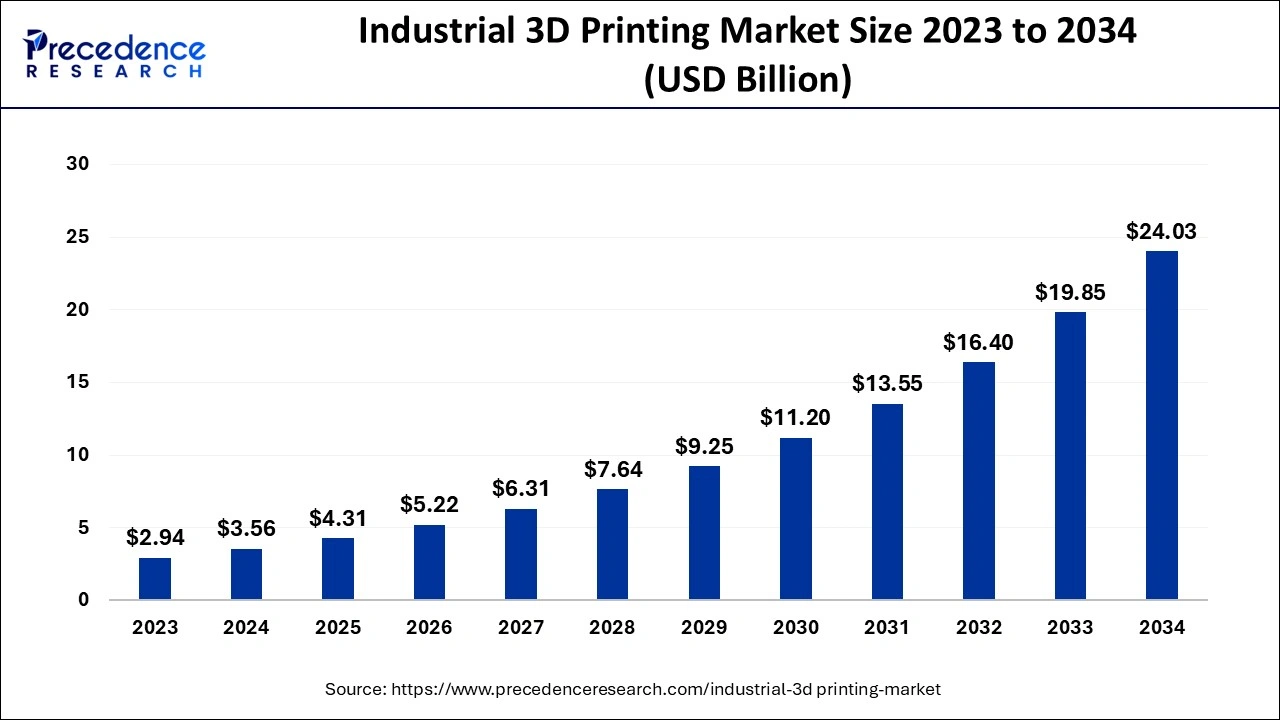
The global industrial 3D printing market is projected to grow from $4.31 billion in 2025 to approximately $27.72 billion by 2035, representing a robust compound annual growth rate of 22.61%. This expansion is driven by the shift from traditional manufacturing toward more agile, on-demand production models that facilitate complex geometries and faster prototyping. As industries like aerospace, healthcare, and automotive increasingly adopt additive manufacturing, the sector is becoming a critical component of modern supply chains and high-performance engineering.
According to the report from Precedence Research, the hardware segment held a dominant position in 2025, particularly through the use of industrial-grade printers for patient-specific medical solutions and small-to-medium production runs in electronics. Stereolithography (SLA) emerged as the leading technology due to its high accuracy and smooth surface finishes required in jewelry and aerospace, while Fused Deposition Modeling (FDM) is expected to see significant growth as an affordable entry point for small and medium-sized enterprises. Furthermore, the software segment is anticipated to be the fastest-growing area, fueled by the integration of artificial intelligence and machine learning to automate design processes and optimize real-time printing parameters.
AI-powered generative design is revolutionizing the sector by allowing developers to produce optimized, lightweight architectures that minimize material waste without sacrificing structural integrity. These algorithms analyze loads and performance restrictions to suggest designs that were previously impossible with conventional manufacturing, while also enhancing demand forecasting and inventory control. The ability to print high-performance components like customized fuel nozzles in aerospace or intricate medical implants underscores the technology's value in creating sturdy yet lightweight parts. Additionally, advancements in processes such as Direct Energy Deposition (DED) and Continuous Liquid Interface Production (CLIP) are accelerating the adoption of novel materials including ceramics and composites.
Despite the optimistic growth projections, the industry faces a significant hurdle in the form of a specialized labor shortage. Effective industrial 3D printing requires a multidisciplinary workforce skilled in mechanical engineering, material science, and post-processing, and the scarcity of these professionals currently hinders broader adoption in high-stakes sectors like healthcare and automotive. However, the move toward distributed manufacturing models offers a compelling sustainability benefit, as printing parts locally reduces reliance on carbon-intensive supply chains and lowers shipping costs. North America remains the leading regional market as of 2025, supported by a well-established industrial base and early adoption across consumer goods and heavy industry.
Summary generated by RabbitReport AI from public reporting. The full article and original reporting belong to Precedence Research.