Fraunhofer ILT Develops Laser System for 2,000-Qubit Neutral-Atom Quantum Computer
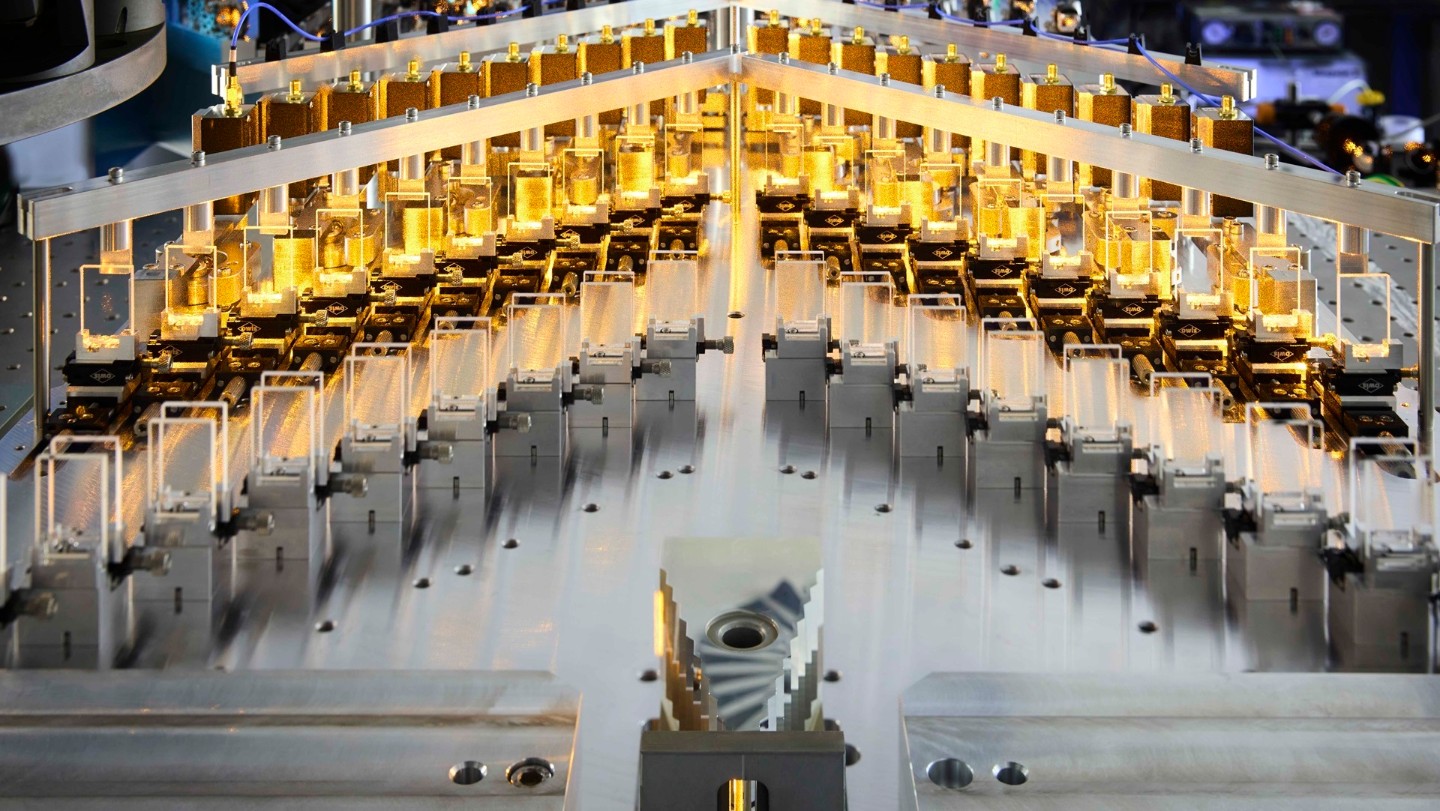
Fraunhofer ILT has developed a sophisticated laser-optical system to support a 2,000-qubit neutral-atom quantum computer currently under construction at the University of Stuttgart. The system utilizes 2,000 individually controllable laser beams as optical tweezers to position strontium atoms with sub-micrometer precision within a compact vacuum chamber. This development represents a critical step in scaling Rydberg atom-based quantum processors, enabling the precise control and interaction of qubits required for complex quantum logic operations.
The laser-optical system developed by Fraunhofer ILT in Aachen is designed to control 2,000 trapped strontium atoms with a positioning accuracy of less than 100 nanometers. By projecting an array of 20 by 100 laser foci into the computer's vacuum chamber, the system creates a stable environment where atoms are spaced exactly 3.5 micrometers apart. This spacing is vital for facilitating two-qubit logic gates, which rely on the controlled interactions between neighboring Rydberg atoms. These atoms are particularly useful for quantum computing because their outer electrons move to distant orbitals when excited, making them highly sensitive to electric fields and allowing for precise electromagnetic control of quantum operations.
Led by Dr. Florian Meinert and Prof. Tilman Pfau at the University of Stuttgart’s 5th Institute of Physics, the project employs a patented fine-structure qubit that operates at a magic wavelength of 592 nm. This specific wavelength ensures that both the qubit states and the Rydberg state are held with equal strength by the optical tweezers, making the system exceptionally robust against external disturbances. The computational logic of the demonstrator is based on the excitation blockade effect, where the strong interaction between two adjacent atoms prevents them from being excited simultaneously. This mechanism allows the researchers to perform reliable quantum operations and implement efficient error correction within the gate array.
To meet the physical constraints of the quantum computer, Fraunhofer ILT integrated over 150 optical components into a compact footprint of just one square meter. The technical architecture, as reported by group leader Dr. Martin Traub, uses cascading beam splitters, acousto-optic deflectors, lenses, and mirrors to split four incoming 20-watt laser beams into the 2,000 individually controllable beams required for the array. This setup creates an intermediate image of the array that is projected into the vacuum chamber with 50x demagnification, allowing for the dynamic rearrangement of the qubit array during ongoing computational processes. The system has already been successfully commissioned on-site in Stuttgart, following comprehensive simulations and testing in Aachen to ensure no further adjustments were needed during installation.
Summary generated by RabbitReport AI from public reporting. The full article and original reporting belong to The Quantum Insider.