Marine Hybrid Propulsion Market Size, Share, Growth, 2034
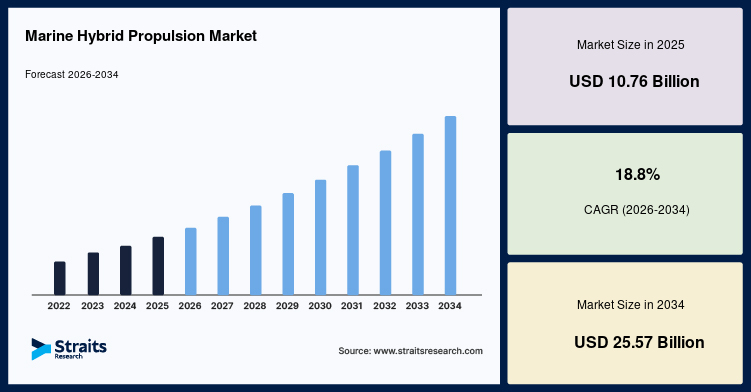
The global marine hybrid propulsion market is projected to expand from $10.76 billion in 2025 to $25.57 billion by 2034, driven by a compound annual growth rate of 18.8%. This growth is fueled by intensifying regulatory pressure to reduce greenhouse gas emissions and a maritime industry-wide shift toward fuel-efficient, sustainable transportation. As Europe maintains a dominant 57.25% market share, the transition is being supported by massive investments in port electrification and the integration of artificial intelligence to optimize vessel energy management.
The marine hybrid propulsion sector is undergoing a rapid transformation as the industry works to meet International Maritime Organization (IMO) goals to curb the nearly 3% of global CO2 emissions generated by international shipping. By 2025, global investments in low-emission fuels and maritime decarbonization projects exceeded $80 billion, accelerating the adoption of systems that combine conventional engines with electric motors and battery storage. These hybrid frameworks allow vessels to operate using either power source independently or both together, optimizing energy distribution during cruising, docking, and low-speed navigation while helping operators manage costs amid rising global trade volumes.
Technological innovation, particularly in artificial intelligence, is a primary catalyst for market expansion by improving vessel energy management and predictive maintenance. AI-driven control systems analyze real-time data such as weather conditions and route patterns to optimize fuel-electric power switching, extending the lifespan of propulsion components. Industry leaders like Wärtsilä Corporation have developed integrated hybrid platforms to support flexible switching in commercial ships, while major ports are investing in shore-power infrastructure. For example, the Port of Rotterdam plans to provide shore power to over 90% of container vessels by 2030, prompting shipbuilders to design systems with standardized charging compatibility.
Despite the positive outlook, the market faces hurdles including the high financial investment required to retrofit older fleets and a lack of structured offshore charging points on long-distance routes. Upgrading existing vessels requires significant structural changes and the installation of complex battery systems, leading many operators to prioritize gradual upgrades. However, the coastal ferry segment offers a major growth opportunity, with over 600 battery-powered or hybrid vessels already in operation or on order globally by 2025. These short-distance routes benefit significantly from battery-assisted propulsion due to frequent stop-and-start operations, driving further demand for advanced energy storage and power management solutions.
Summary generated by RabbitReport AI from public reporting. The full article and original reporting belong to Straits Research.