Medicare Advantage Enrollment Reaches 55% of Beneficiaries in 2026 Amid Rising Federal Spending
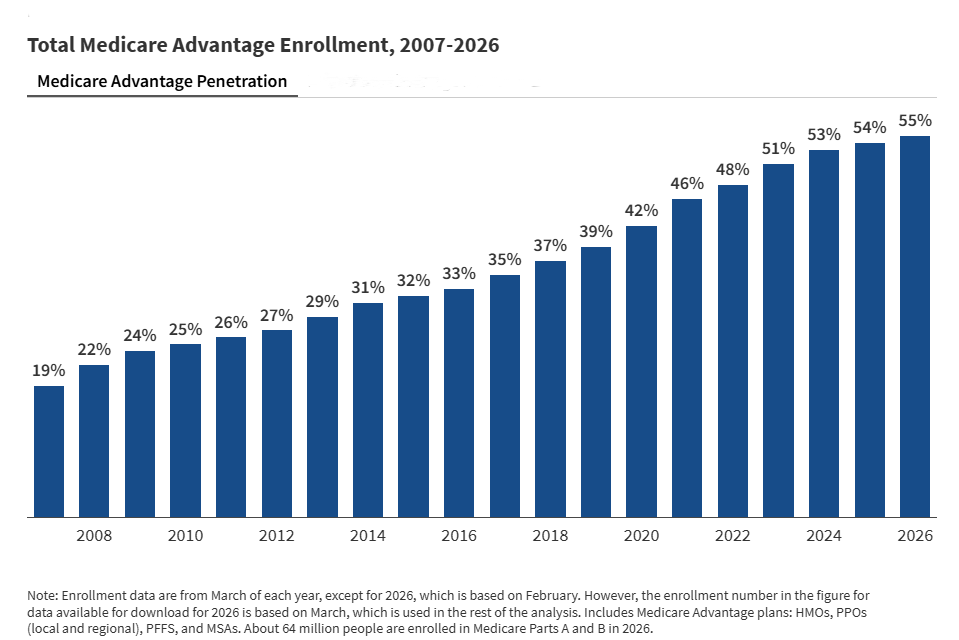
Medicare Advantage enrollment has reached a record 55% of eligible beneficiaries in 2026, representing 35 million individuals and driving a significant shift in the healthcare payer landscape. This growth has resulted in $76 billion in additional federal spending compared to traditional Medicare, as private plan payments now exceed traditional costs by 14% per person. For the Data & Analytics sector, this trend underscores a critical need for advanced population health modeling and actuarial precision as specialized plans, particularly Special Needs Plans (SNPs), become the primary engine of market expansion.
According to the latest KFF analysis, Medicare Advantage (MA) enrollment has grown to include 35 million of the 64 million eligible beneficiaries in 2026. This 55% market penetration reflects a steady climb from just 19% in 2007, with the Congressional Budget Office projecting a further increase to 63% by 2034. The financial implications are substantial; the Medicare Payment Advisory Commission (MedPAC) reports that payments to private plans are 14% higher per person than traditional Medicare. This disparity accounts for $76 billion in additional federal spending this year, a sharp increase from the $24 billion impact seen a decade ago when enrollment was significantly lower and only one-third of beneficiaries were in private plans.
The growth is increasingly driven by Special Needs Plans (SNPs), which accounted for 85% of the net increase in MA enrollment over the past year. Nearly 8.2 million beneficiaries are now enrolled in SNPs, which target individuals with specialized care needs or those dually eligible for Medicare and Medicaid. This segment now represents 23% of all MA enrollees, up from 21% in 2025. The rise in SNP popularity is attributed to higher rebate payments—which have more than doubled since 2017—and the permanent status granted to these plans by the Bipartisan Budget Act of 2018. These financial structures allow plans to offer supplemental benefits like dental, vision, and hearing, which are key drivers of consumer choice and market competition.
Data and analytics challenges are mounting as policymakers scrutinize how Medicare pays these private plans and the efficiency of supplemental benefit delivery. The Centers for Medicare & Medicaid Services (CMS) discontinued the Medicare Advantage Value-Based Insurance Design (VBID) model in 2025, citing the 'unprecedented cost' of the program, including increased rebates and Part D expenditures. This model previously allowed plans to use socioeconomic data to provide non-medical benefits such as food, utilities, and transportation. As the program shifts away from these broad experimental models, insurers and data providers must refine their predictive modeling and risk adjustment strategies to manage costs while maintaining the attractive supplemental offerings that sustain enrollment growth.
Summary generated by RabbitReport AI from public reporting. The full article and original reporting belong to KFF.