IoT Analytics Market Projected to Reach $201.77 Billion by 2034 Driven by AI and Digital Transformation
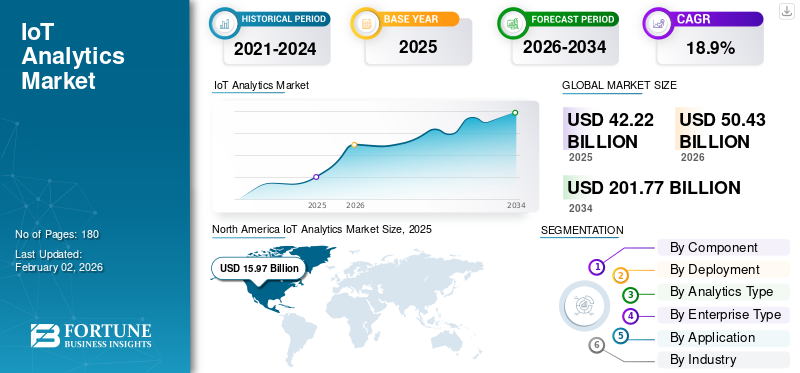
The global IoT analytics market is expected to grow from a 2025 valuation of $42.22 billion to $201.77 billion by 2034, representing a compound annual growth rate of 18.9%. This expansion is driven by the rapid proliferation of connected devices, government-led smart infrastructure projects, and a fundamental shift toward treating IoT data as a strategic enterprise asset. For the Data & Analytics sector, this trend signals a move away from simple monitoring toward autonomous, self-optimizing systems powered by generative AI and edge computing.
The IoT analytics market is experiencing a significant surge, with North America leading the sector by accounting for 38.52% of the global market share in 2025. According to the report, the industry is projected to grow from $50.43 billion in 2026 to over $201 billion by 2034 as organizations integrate AI and machine learning to extract actionable insights from sensors, wearables, and industrial machinery. This growth is heavily supported by Industry 4.0 initiatives and large-scale government programs, including intelligent transportation networks and utility modernization, which rely on real-time predictive analytics to optimize energy efficiency and public safety.
Technology is evolving from basic visualization tools into integrated intelligence systems, with Generative AI playing a pivotal role in transforming how enterprises interact with data. GenAI enables natural-language querying of complex sensor datasets and automates the creation of predictive models, allowing for rapid scenario simulation through digital twins. This shift toward edge intelligence and distributed architectures is particularly critical for latency-sensitive applications in industrial automation, where decision-making must happen at the point of data generation rather than in a centralized cloud.
The competitive landscape is currently dominated by major players such as Microsoft, Amazon Web Services, Google, IBM, and Oracle, who are focused on providing end-to-end, interoperable platforms. These providers are increasingly incorporating sustainability analytics into their offerings to help corporations meet ESG reporting requirements and carbon reduction targets through real-time monitoring of emissions and resource usage. However, the report cautions that while the market outlook is strong, enterprises must still navigate significant hurdles regarding data security, integration complexity, and demonstrating clear return on investment.
Summary generated by RabbitReport AI from public reporting. The full article and original reporting belong to Fortune Business Insights.