NCAME Partners with 6K Additive to Close the Data Gap Holding Back Cold Spray Repair
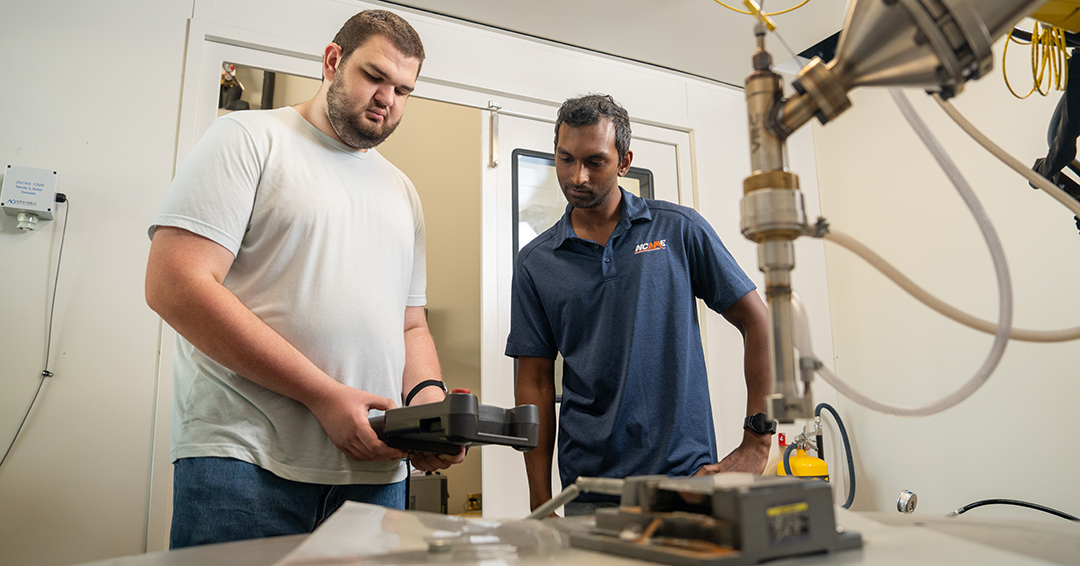
Auburn University’s National Center for Additive Manufacturing Excellence (NCAME) and metal powder producer 6K Additive have initiated a study to evaluate the mechanical performance of cold spray feedstock materials. This research addresses the data deficiency that currently prevents the widespread adoption of cold spray technology for critical repair and sustainment operations in the defense and industrial sectors. By establishing standardized performance benchmarks, the project aims to facilitate the qualification of cold spray processes for real-world field applications.
The collaborative research project, led by NCAME research engineer Mikyle Paul, utilizes the center’s VRC Gen IV Cold Spray System to test a range of feedstock materials under demanding conditions. The study is designed to generate the mechanical performance and strength data required to support repair strategies for critical components across various industrial sectors. By focusing on how these materials behave in field repair scenarios, the team hopes to provide the structural reliability data that procurement and maintenance engineers need to move beyond proof-of-concept to full-scale adoption.
Cold spray technology offers unique benefits for additive manufacturing, including the ability to deposit material without melting, which maintains the integrity of the underlying substrate. This makes it particularly suitable for defense and industrial repairs where field deployment is necessary. However, the lack of standardized benchmarks for specific feedstock materials has created a qualification bottleneck. NCAME laboratories manager Scot Carpenter noted that understanding material limitations is key to reducing downtime and costs while improving operational readiness in sectors where reliability is paramount.
This initiative complements other ongoing research in the field, such as the NASA-funded project involving the University of Utah, Penn State, and Elementum 3D, which explores particle-level bonding for GRX-810. Similarly, Florida International University is working with SPEE3D’s WarpSPEE3D system to apply cold spray to complex aerospace geometries. The NCAME and 6K Additive study adds a unique dimension by offering systematic feedstock characterization across multiple materials, aiming to create a transferable evidence base that could serve as a reference point for the entire additive manufacturing industry.
Summary generated by RabbitReport AI from public reporting. The full article and original reporting belong to 3D Printing Industry.