Sandia National Laboratories and Quantinuum Announce Major Results for 98-Qubit Helios System
Sandia National Laboratories and Quantinuum have published peer-reviewed results in the journal Nature detailing the performance of the 98-qubit Helios quantum computing system. The commercial system demonstrated record-breaking fidelity levels of 99.9975% for single-qubit operations and 99.921% for two-qubit operations. These findings represent a significant step toward achieving fault-tolerant quantum computing, which is essential for solving complex problems in cryptography, pharmaceuticals, and national security.
The published research confirms that Quantinuum’s Helios system, a trapped-ion quantum computer, has established new benchmarks for reliability and complexity in the sector. Sandia National Laboratories, which has collaborated with Quantinuum for four years under a Cooperative Research and Development Agreement, played a critical role in evaluating and certifying the system's performance. According to Helios lead architect Tony Ransford, the system now operates beyond the capabilities of classical simulation alone, marking it as the company's largest and most reliable quantum computer to date.
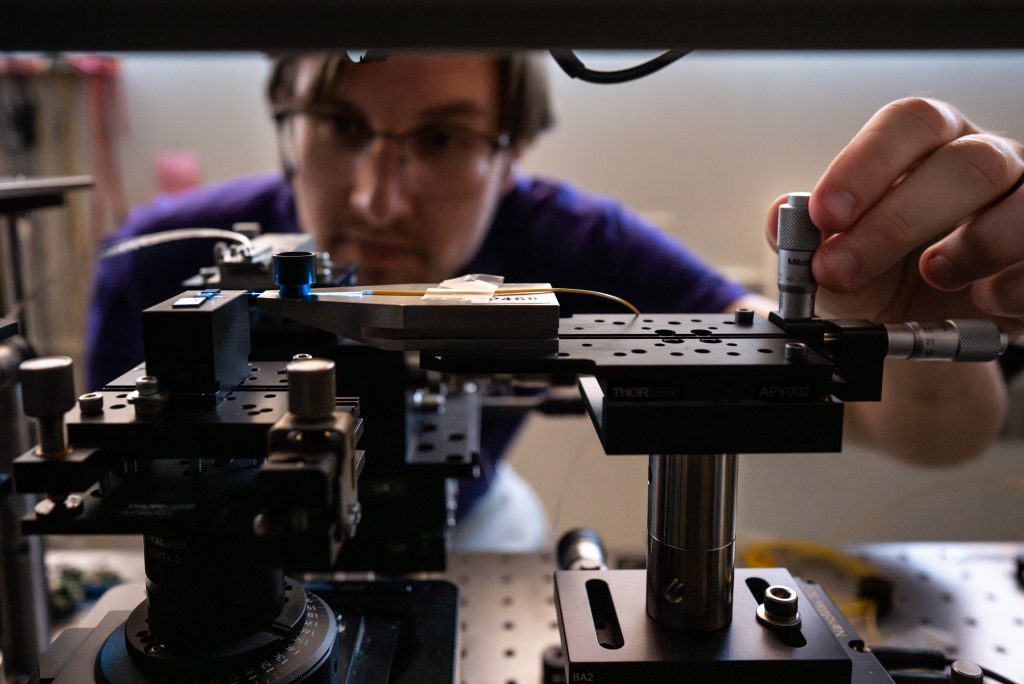
A central focus of the collaboration involves the development of integrated photonics, which are energy-efficient chips designed to carry information via microscopic optical channels. These components are intended to improve scalability and reduce energy costs, addressing two of the primary hurdles in building large-scale, useful quantum computers. Sandia researchers also introduced a new benchmarking methodology specifically for mid-circuit measurements—non-destructive readout operations that are vital for the error correction necessary to reach fault tolerance.
The partnership highlights the growing synergy between national laboratories and private industry to accelerate quantum supercomputing. Sandia senior manager Mike Descour emphasized that such collaborations support both economic and national security by advancing technologies relevant to advanced sensing, communications, and energy science. Robin Blume-Kohout of Sandia noted that the current priority for the industry is reliability over raw speed, as the ability to debug and correct subtle experimental failures is what will ultimately allow quantum systems to tackle previously unsolved scientific problems.
Summary generated by RabbitReport AI from public reporting. The full article and original reporting belong to Sandia National Laboratories (.gov).