Oil & Gas Cybersecurity Market Projected to Reach $78.93 Billion by 2034 Amid IT/OT Convergence
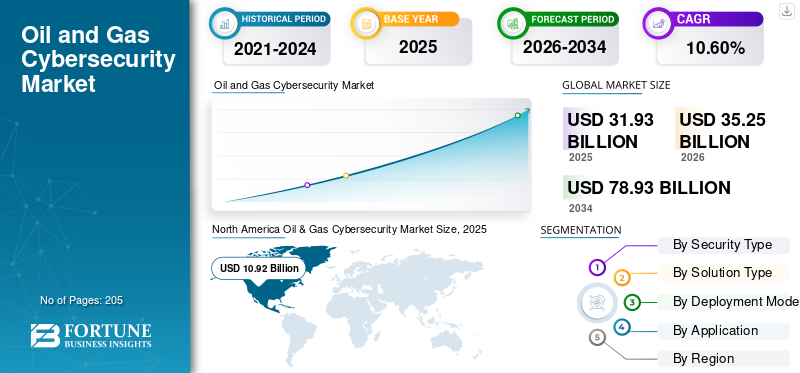
The global oil and gas cybersecurity market is set for significant expansion, growing from an estimated $31.93 billion in 2025 to nearly $79 billion by 2034. This growth is primarily driven by the convergence of legacy operational technology (OT) with modern information technology (IT) networks, which has introduced new vulnerabilities to critical energy infrastructure. As the sector faces increasingly sophisticated threats to pipelines and refineries, cybersecurity has become essential for maintaining operational continuity and safety across the global energy supply chain.
The market is experiencing a compound annual growth rate of 10.60%, with North America leading the sector with a 34.19% market share as of 2025. Key drivers include the rising frequency of targeted attacks on infrastructure like refineries and pipelines, alongside the expansion of IoT-enabled sensors and cloud-based analytics in digital oilfields. Major industry players such as Honeywell International, Siemens AG, Schneider Electric, and ABB Ltd. are responding by providing advanced industrial control systems (ICS) and robust security frameworks. Regulatory pressure for critical infrastructure protection is further compelling operators to adopt these advanced solutions to mitigate the risk of large-scale supply disruptions.
To combat a shortage of specialized OT security talent, many energy giants are turning to Managed Security Services (MSS) and outsourced Security Operations Centers (SOC). For example, Shell expanded its external cybersecurity collaborations in mid-2023 for 24/7 monitoring, while ADNOC enhanced its centralized SOC capabilities in early 2024 to oversee upstream and midstream operations. Additionally, the shift toward edge computing—led by operators like Equinor and BP in the North Sea—is creating a need for decentralized threat intelligence and autonomous security capabilities. These technologies allow for real-time decision-making at remote drilling rigs and offshore platforms but require enhanced security layers to protect against localized intrusions.
Despite the growth, the industry faces significant hurdles in securing legacy OT systems that lack modern encryption or authentication features. In 2022, several European refinery operators were forced to delay security upgrades due to concerns over system compatibility and potential operational downtime. However, the transition to low-carbon energy presents new opportunities, as Carbon Capture, Utilization, and Storage (CCUS) projects and hydrogen infrastructure require complex monitoring platforms. Projects like Equinor’s Northern Lights CO2 storage initiative are already driving demand for specialized cybersecurity frameworks to protect cross-border data flows and hybrid energy assets.
Summary generated by RabbitReport AI from public reporting. The full article and original reporting belong to Fortune Business Insights.