AI in Bioinformatics Market Projected to Reach $4.8 Billion by 2034 Driven by Precision Medicine and Multi-Omics Data
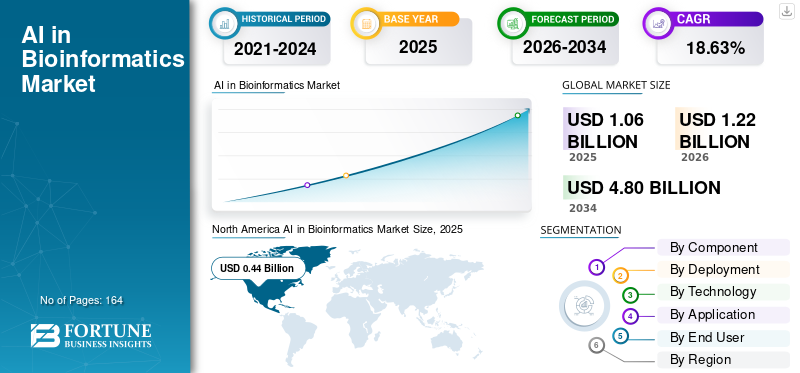
The global AI in bioinformatics market is poised for significant growth, expanding from a valuation of $1.06 billion in 2025 to an estimated $4.80 billion by 2034. This expansion is primarily fueled by the increasing volume of sequencing and multi-omics data, alongside a strategic shift toward data-informed personalized care in the precision medicine sector. As pharmaceutical and biotechnology firms seek to accelerate drug discovery and enhance clinical decision-making, AI-driven platforms are becoming essential for managing complex biological datasets.
The global AI in bioinformatics market is experiencing a robust compound annual growth rate (CAGR) of 18.63%, with North America leading the sector with a 41.51% market share as of 2025. Key industry participants, including Illumina, Tempus, SOPHiA GENETICS, DNAnexus, and Fabric Genomics, are increasingly focusing on AI-enhanced genomics analysis, clinical decision support, and precision health data systems. The software segment currently holds the largest market share, as organizations prioritize scalable, cloud-based bioinformatics platforms to handle the massive influx of sequencing and multi-omics data generated by modern research.
Precision medicine is emerging as a primary long-term growth engine, as healthcare providers move away from generic treatments toward molecular profiling and patient categorization. AI tools are now critical for identifying disease patterns and treatment responses by collectively analyzing genomic, transcriptomic, and clinical data. In the realm of drug discovery, these platforms reduce the time required for target discovery and molecule selection by linking genomic findings directly to disease mechanisms. This integration of biological data is essential for biotechnology firms aiming to enhance R&D efficiency, support biomarker discovery, and rank drug candidates more effectively.
Despite the optimistic growth projections, the sector faces significant hurdles related to data integration and a shortage of multidisciplinary talent. Integrating disparate datasets—such as proteomics, imaging, and clinical records—remains a complex task that can delay deployment and increase implementation costs due to variations in data quality and storage infrastructure. Furthermore, a lack of experts possessing a blend of skills in AI, genomics, and computational biology hinders the effective use of these technologies, particularly in emerging markets and public research environments. However, rising investments in biotechnology research continue to create new revenue opportunities for vendors offering integrated analytics across sequencing and discovery workflows.
Summary generated by RabbitReport AI from public reporting. The full article and original reporting belong to Fortune Business Insights.